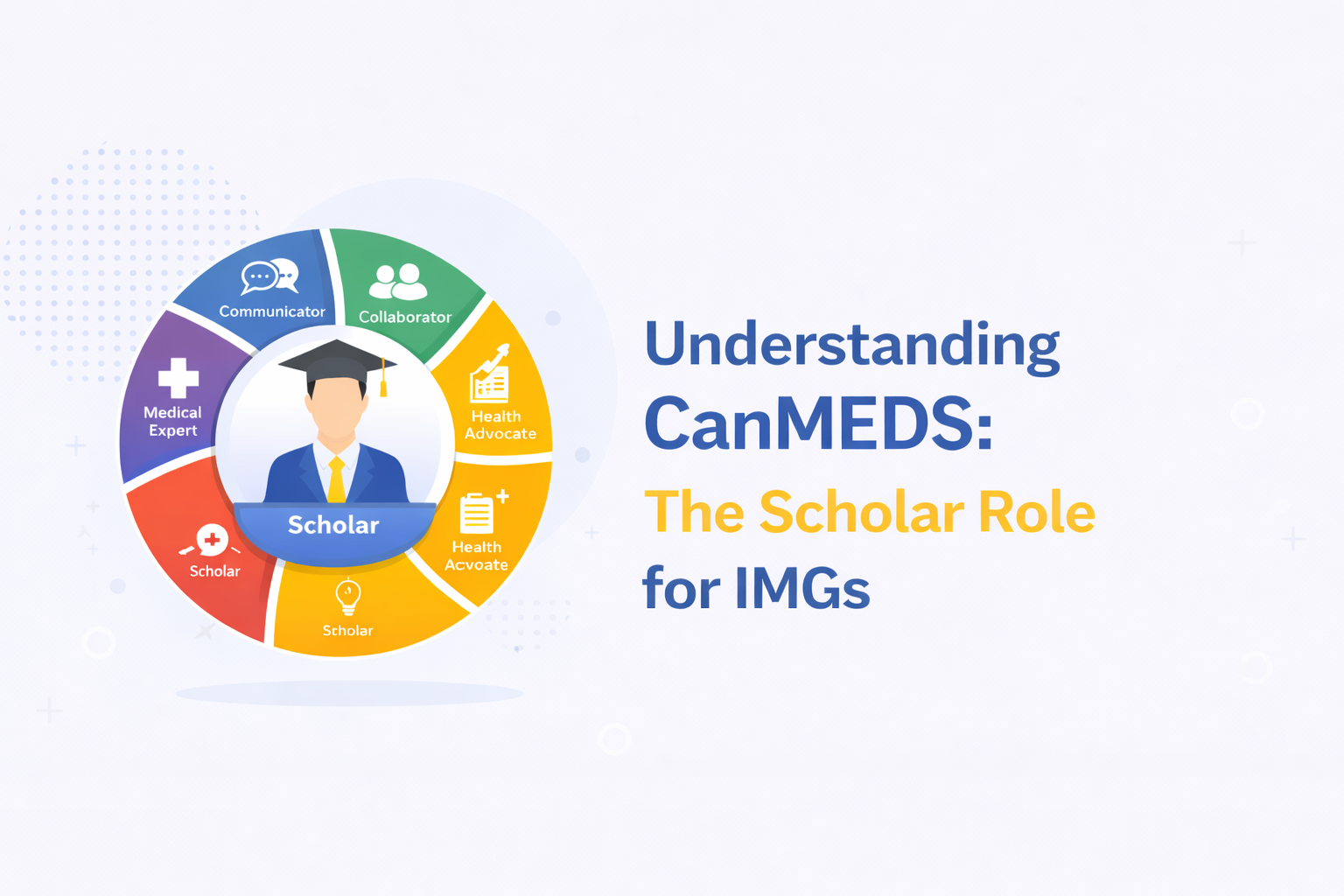
The CanMEDS Scholar role goes beyond memorizing facts – it’s about lifelong learning, teaching others, and applying evidence critically, a must for MCCQE1 ethics questions and CaRMS interviews. This guide breaks down its core competencies and how IMGs build it using mccQbank practice.
Lifelong Self-Learning: Staying Current in a Changing Field
Scholars actively seek knowledge gaps and pursue self-directed learning, like scanning UpToDate for new guidelines or auditing webinars on AI diagnostics.
IMG Fix: After every mccQbank block, note 3 “why wrong?” insights. Subscribe to 2 Canadian journals (CMAJ, CPSO updates) – 15 mins daily keeps you ahead of evolving MCC objectives.
Critical Appraisal: Judging Evidence Quality
This means dissecting studies for bias, relevance, and applicability – e.g., “Does this RCT fit my diabetic patient from rural Ontario?”
IMG Fix: For 10 mccQbank ethics questions weekly, outline: Population? Intervention? Outcomes? Apply to vignettes. Free tools like CASP checklists sharpen this fast.
Knowledge Creation: Research and Innovation
Scholars contribute via audits, case reports, or quality projects – even small QI like optimizing handover sheets counts for portfolios.
IMG Fix: Log one rotation project monthly: “Reduced order errors 20%.” Use mccQbank analytics for personal “study” – publish anonymized trends on MedEd forums.
Knowledge Dissemination: Teaching and Mentoring
Explain complex ideas simply to patients, peers, or students – think breaking down statin risks or leading journal club.
IMG Fix: Teach 1 mccQbank topic daily to a mirror or peer via Zoom: “In plain language…” Record NAC-OSCE stations emphasizing teach-back: “Does this make sense?”
For IMGs, Scholar bridges knowledge to Canadian practice – weak here hurts OSCEs and apps. Dive into mccQbank’s questions to log real examples today.
This is one of the seven CanMEDS roles. For an overview of all seven roles, see what CanMEDS is and the seven roles.