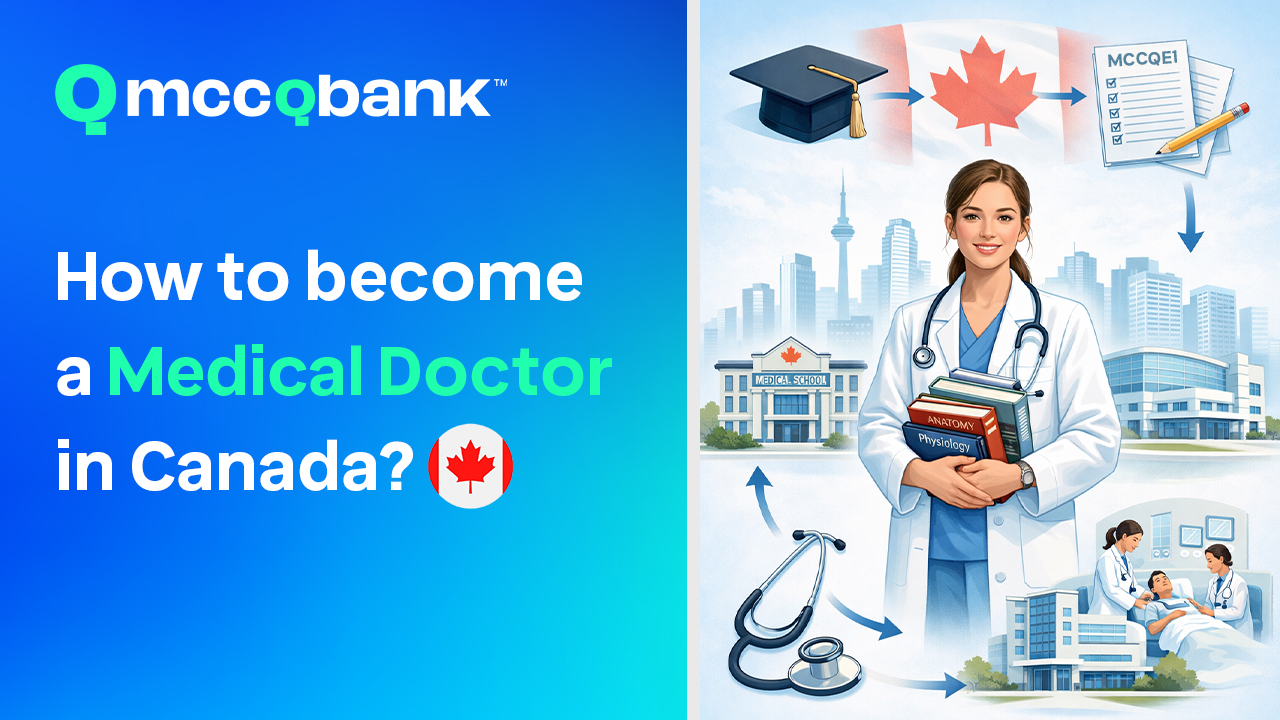
We are sure that you are career-oriented and when it comes to a secure career, a high-paying job, a settled life and an uplifting career, becoming a medical doctor in Canada is the best choice you could make. But how? How will you start and how will you reach that apex of your career? This guide provides a comprehensive overview of the steps involved, including education, exams, and residency training to become a doctor in Canada. Whether you’re a high school student or considering a career change, understanding the path to becoming a doctor in Canada is essential.
Roadmap for becoming a Doctor in Canada
1. Post Secondary Education
2. Medical Degree
3. MCCQE1 exam
4. Residency Training
5. LMCC, then a licence from your provincial or territorial regulator
Phew! That seems to be a long journey, isn’t it? Well, it is. But don’t worry we have got all the information here for you to become a doctor in Canada.
So, let’s begin by telling you about the process of becoming a doctor in Canada shortly and sweetly.
Step-1 Obtaining a University Degree
The first step is university study. Academic requirements differ from school to school. In the AFMC’s Admission Requirements of Canadian Faculties of Medicine 2027, for example, Western asks for at least three years of an undergraduate degree and lists no prerequisite courses, while McMaster asks for three years of undergraduate university education in any field of study. So if you are aiming for specific medical schools, check each school’s own requirements and prerequisites.
How to get an advantage over others?
- You may volunteer in various healthcare departments while obtaining your university degree. However, this is not mandatory but it will help you to make better decisions in your career.
- Take Science Subjects in your university degree
Step-2 Take the MCAT (Medical College Admissions Test)
MCAT is an exam which will help you to become a doctor in Canada. The AFMC describes it as “a computer-based standardized examination for prospective medical students in the United States and Canada”, developed and administered by the AAMC (AFMC: Aspirants & Applicants). Not every Canadian school requires it: the AFMC’s 2027 admissions guide lists the MCAT as not required at, for example, the University of Ottawa, McGill, NOSM University and Toronto Metropolitan University. Your objective is to score as high as you can to get a seat in your favourite school. You must Familiarize yourself with the prerequisites of your target medical schools.
According to the AFMC, it is designed to assess “problem solving, critical thinking, and knowledge of natural, behavioural, and social science concepts and principles prerequisite to the study of medicine”. The AAMC limits attempts: no more than three in a testing year, four over two consecutive testing years and seven in your lifetime, counting from the April 2015 test dates (AAMC: Testing Attempt Limits).
How to get an advantage over others?
- Score as high as you can
- Thoroughly go through the prerequisites of the Medical School you want to get into
Step-3 Take a degree from 1 of the 19 prestigious Canadian Medical Schools
Now that you have taken the MCAT to become a dr in Canada, it’s time to apply to Medical schools in Canada. You need to finish your medical degree at one of the 19 faculties of medicine in Canada (AFMC). Program length differs: the AFMC’s 2027 admissions guide lists four years at schools such as Toronto, Western and UBC, and three years at McMaster and Calgary. Manitoba, for example, describes Med 1 and Med 2 as pre-clerkship and Med 3 and Med 4 as clerkship.
Attending the Medical program will earn you a degree as well as a thought process of what kind of residency program you want to take after you graduate from medical school.
Step-4 Pass MCCQE1 (Medical Council of Canada Qualifying Exam)
Just getting a degree is not enough if you ask us how to become a medical doctor in Canada. Passing the MCCQE (formerly MCCQE Part I) is one of the eligibility criteria for the Licentiate of the Medical Council of Canada (LMCC), and Canadian medical regulatory authorities may require the LMCC before you apply for a medical licence (MCC: MCCQE). The MCC says the exam “assesses the critical medical knowledge and clinical decision-making ability of a candidate at a level expected of a medical student who is completing their medical degree in Canada”.
Step-5 Residency Training
Now, you are even closer to your dream of becoming a medical doctor in Canada. The next step is to apply to the residency programs through CaRMS. However, you must ensure to see the perquisite of the programs because some programs might have specific requirements to be met.
The residency programs require rigorous working hours and endless pressure to make you fit to step into the real medical world. Residency involves intense training and long hours, preparing you for independent practice.
Step-6 Become LMCC (Licentiate of the Medical Council of Canada)
The LMCC is granted by the Medical Council of Canada and is part of the requirements that provincial and territorial medical regulatory authorities set for issuing a licence to practise in their jurisdictions (MCC: LMCC). As of 26 January 2026, the MCC’s LMCC eligibility criteria are graduation from an accepted medical school, a pass result on the MCCQE, source-verified medical credentials, and payment of the LMCC application fee with no outstanding MCC fees. If you applied for the MCCQE after 26 January 2026, the LMCC is issued automatically at no additional cost.
You receive a digital LMCC number as official proof of registration in the Canadian Medical Register, one more step towards completing your dream of becoming a doctor in Canada.
Conclusion
The journey of becoming a doctor in Canada takes many rigorous years: university study, a medical degree, the MCCQE and residency. The Canadian system wants more experienced doctors to finally lay hands on the patient’s problems and step into the real world. The journey will check your persistence, emotional intelligence and ability to handle pressure under difficult situations. The mo