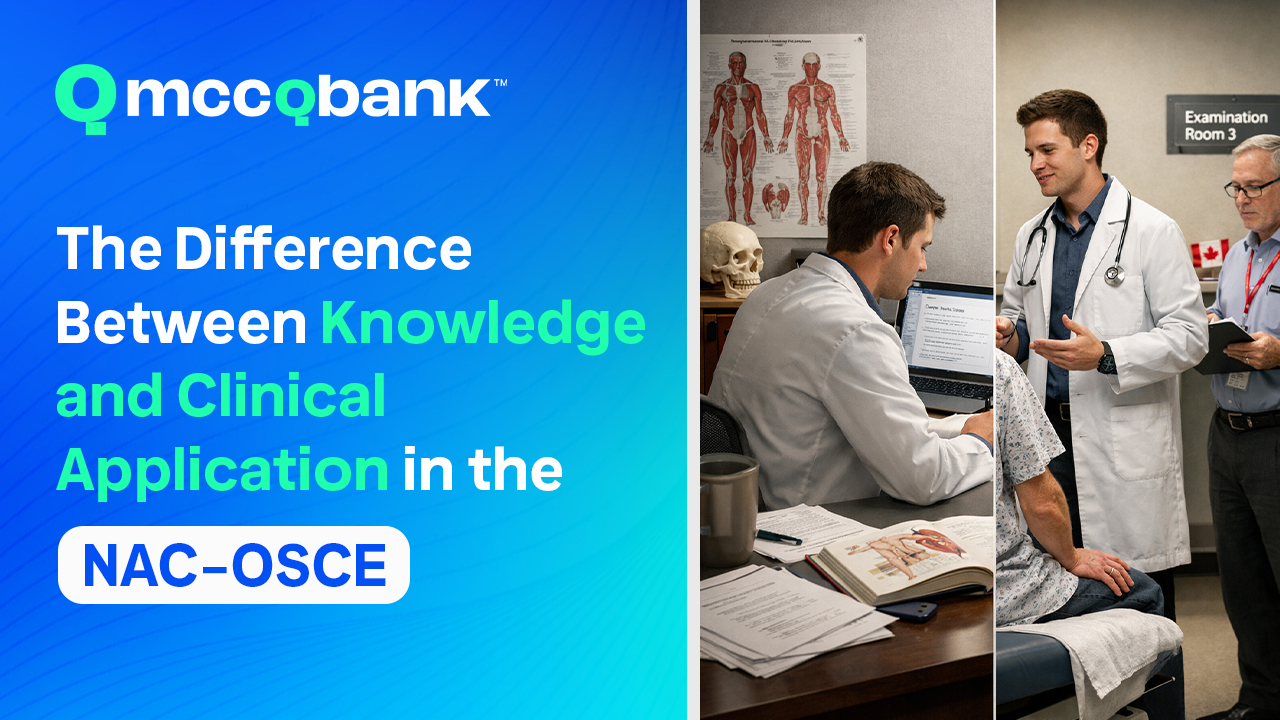
Preparing for the NAC-OSCE requires a different approach compared with written medical exams. While medical knowledge is still important, the NAC-OSCE primarily evaluates how well candidates apply that knowledge in real clinical interactions.
Many candidates enter the exam with strong theoretical understanding but struggle because they are not accustomed to demonstrating their thinking while interacting with patients. The NAC-OSCE is designed to assess how effectively you can translate knowledge into practical clinical skills.
Medical Knowledge: The Foundation
Medical knowledge forms the foundation for clinical performance. Candidates must understand common conditions, diagnostic approaches, and management strategies across different specialties.
For example, candidates should know the key symptoms of common diseases, appropriate investigations, and standard treatment approaches. This knowledge helps guide clinical decision-making during patient encounters.
However, simply knowing the information is not enough for success in the NAC-OSCE. The exam focuses on how candidates apply this knowledge during patient interactions.
Clinical Application During OSCE Stations
The NAC-OSCE consists of multiple stations where candidates interact with standardised patients and demonstrate clinical skills such as history taking, physical examination, communication, and patient counselling.
At each station, candidates must apply their knowledge to the specific scenario presented. This involves gathering relevant information, forming clinical impressions, and communicating clearly with the patient.
A key point many candidates overlook is that examiners assess not only what actions you perform but also how you communicate your reasoning during the encounter.
During every station, you should clearly explain what you are doing while performing any clinical action.
For example, if you are performing a physical examination, you should explain to the patient what you are about to do and why it is necessary.
Always speak while you perform clinical actions at the station so the examiner understands your thought process.
This communication helps demonstrate your clinical reasoning and ensures the examiner can properly evaluate your performance.
Why Demonstrating Clinical Reasoning Matters
In the NAC-OSCE, examiners are observing how candidates approach clinical problems in real time. Candidates who remain silent while performing actions may lose valuable marks because the examiner cannot assess their reasoning.
By verbalising your approach, you demonstrate:
- Clinical reasoning
- Patient-centred communication
- Professionalism and clarity
These skills are essential for practising medicine in Canada and are a major focus of the NAC-OSCE assessment.
Preparing Effectively for the NAC-OSCE
Success in the NAC-OSCE comes from combining medical knowledge with strong communication and clinical skills. Candidates should practise patient scenarios, role-play clinical encounters, and become comfortable explaining their actions during examinations.
Developing this habit ensures that your clinical reasoning is visible to the examiner and that you communicate effectively with patients throughout the station.
With consistent practice and a focus on both knowledge and clinical application, candidates can approach the NAC-OSCE with greater confidence and perform more effectively during each station.