By Dr. Bilal Akil, MD — Emergency Medicine, Schulich School of Medicine & Dentistry, Western University · founder of mccQbank
You do not need to guess what to study for the MCCQE (MCCQE1). The Medical Council of Canada (MCC) publishes what the exam tests (its Examination Objectives), how the questions are spread (a blueprint of eight domains), what the day looks like (230 questions in two timed sections), and the score you need (439 on a 300 to 600 scale). A good plan is built on those four facts.
What follows is a 16-week MCCQE study plan built that way. The exam facts in it come from the MCC’s own pages, linked in each section and read on 4 October 2026. The week-by-week structure is our recommendation, not an MCC requirement.
The short answer
- Study against the MCC Examination Objectives, not a textbook’s table of contents. The MCC calls them its guide when it writes questions.
- Use timed multiple-choice practice as the main engine, because that is the whole exam: 230 MCQs, 2 hours 40 minutes for each section of 115.
- Spread your practice across all eight blueprint domains, not only the clinical ones you enjoy.
- Use the MCC’s own preparatory exam as a checkpoint, not as your first practice set.
- Book only when you can sit a full timed set and finish it. You may take the MCCQE at most four times, and starting the exam counts as an attempt.
What the MCC says you are preparing for
What it tests. The MCCQE assesses “critical medical knowledge and clinical decision-making ability” at the level expected of a student completing a medical degree in Canada, using multiple-choice questions (MCC: the MCCQE). Questions are based on the MCC Examination Objectives, which are organized by CanMEDS role. Under the Medical Expert role, the objectives are further organized by clinical presentation/diagnosis, population health and its determinants, and ethics, legal and organizational aspects of medicine (MCC Examination Objectives).
How questions are spread. The blueprint has two categories with four domains each, and the MCC gives every domain a content weighting (MCC: the MCCQE). Dimensions of care: Health Promotion and Illness Prevention 20% (±5), Acute 35% (±5), Chronic 30% (±5) and Psychosocial Aspects 15% (±5). Physician activities: Assessment/Diagnosis 45% (±5), Management 35% (±5), Communication 10% (±5) and Professional Behaviours 10% (±5). Communication and Professional Behaviours together carry about a fifth of the physician-activities weighting, so a candidate who is strong on acute diagnosis can still lose marks there. The MCCQE study plan below makes you practise all eight domains.
What the day looks like. Each appointment is 6.5 hours. You get 2 hours 40 minutes for each section of 115 questions, about 1 minute 23 seconds a question, with one optional 45-minute break between sections. Once you leave a section you cannot go back, and unanswered questions are marked incorrect (MCC: exam day). Our post on how long the MCCQE is walks through the day.
What you need to score. Total scores run from 300 to 600 and the pass score is 439. Your result depends only on where your score falls against 439, “regardless of how well other candidates perform”. The total is calculated from both your answers and each question’s difficulty, so it is not a simple percentage (MCC: results).
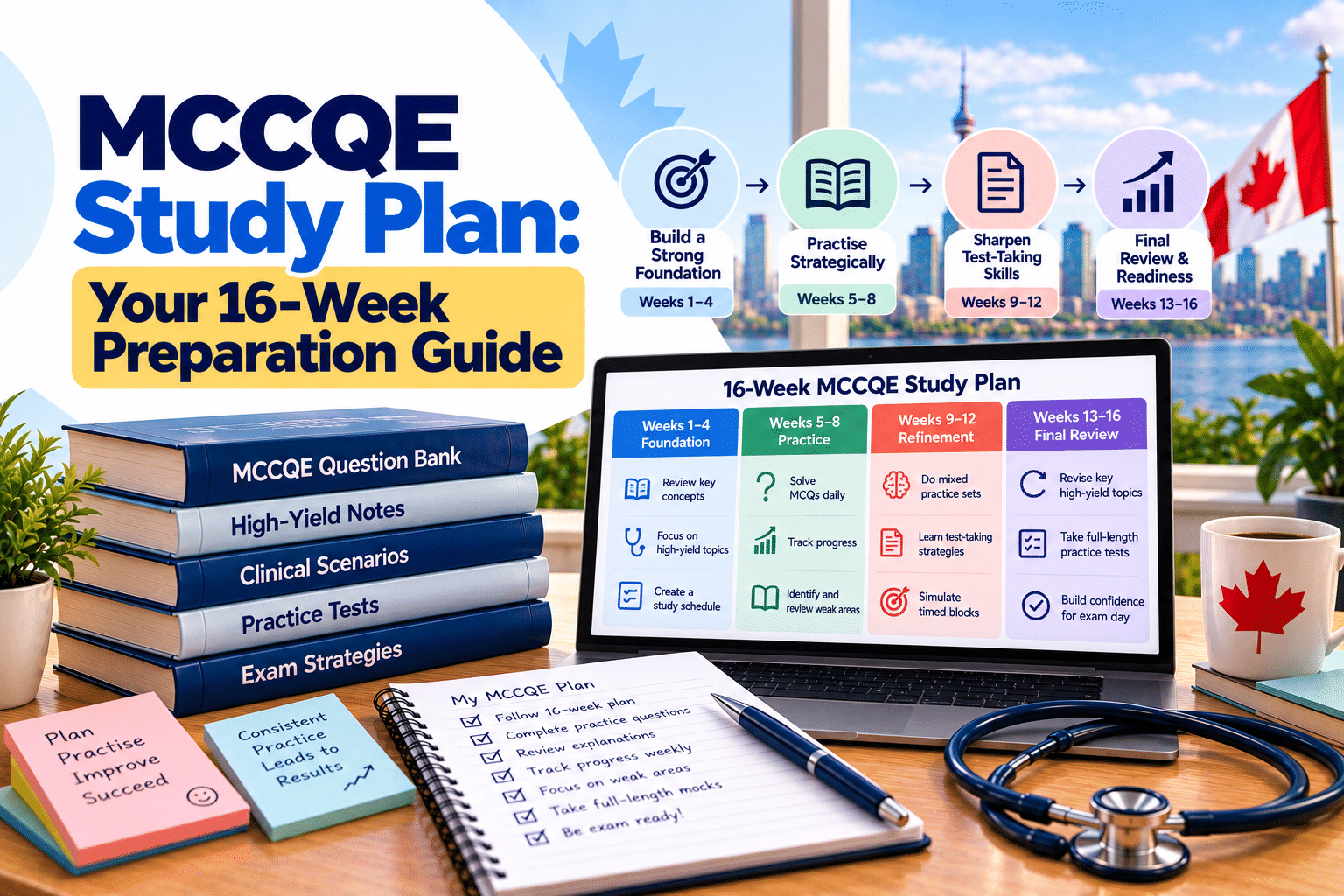
Your 16-Week MCCQE Study Plan
This MCCQE study plan assumes you can study close to full time. If you work full time, stretch each phase; our plan for candidates working full time has the scheduling side. The question counts below are targets, not rules.
| Weeks | Phase | What you do | Practice target |
|---|---|---|---|
| 1 | Baseline | Skim the objectives for every CanMEDS role. Do one timed block of mixed questions with no preparation, and record your score by domain. | 1 timed mixed block |
| 2–7 | Build | Work through the objectives system by system. After each topic, do untimed questions on it, then read every explanation, including for questions you got right. | 40–60 questions a day, untimed, by topic |
| 8–11 | Mix | Switch to timed, mixed blocks across all eight domains. Keep an error log: for each miss, write whether it was knowledge, reading or time. | 2–3 timed mixed blocks a week; review every miss |
| 12 | Checkpoint | Sit one MCC preparatory exam under timed-exam mode in one sitting. Compare your weak domains with your error log. | 1 full preparatory exam |
| 13–14 | Close gaps | Spend most of your time on the two or three weakest domains from week 12, with mixed timed blocks to keep the rest warm. | Timed blocks weighted to weak domains |
| 15–16 | Rehearse | Full-length timed practice at exam pace, then taper. Our day-by-day plan for the last two weeks covers this phase in detail. | 1–2 full-length sets; light review in the final days |
Why Week 12 of Your MCCQE Study Plan Includes a Preparatory Exam?
The MCC sells three preparatory products: the Preparatory Examination (230 questions, $400 per form), the $1 Preparatory Examination (230 questions, a different question set, an “ongoing price offer”), and the PE-Lite (115 questions, $250 per form, two forms). Each comes with answer rationales, timed or self-paced modes and six months of access, and each form is meant to be taken once (MCC: preparatory products).
Because each form can only be taken fresh once, it is wasted as a first practice set. Take it when you have covered the objectives in your MCCQE study plan and can sit a timed exam. That way it measures readiness instead of exposing topics you have not studied yet. Our post on the MCC’s $1 Preparatory Exam covers how to use it alongside a question bank. The MCC also offers free resources, including sample questions, clinical cases and a study guide, on its exam preparation page, and on 22 July 2025 it announced 55 free MCC-style practice questions.
3 Mistakes That Can Derail Your MCCQE Study Plan
Studying only the clinical domains. Communication and Professional Behaviours are weighted at 10% (±5) each, and Health Promotion and Illness Prevention at 20% (±5) (MCC: the MCCQE). Questions on ethics, consent, public health and screening feel soft until you meet them timed.
Reading explanations only when wrong. A correct guess teaches nothing unless you check why the answer was right. Read the explanation for every question in the build phase.
Booking too early. The MCC allows a maximum of four attempts. Once you start the exam it counts as an attempt, and after a third attempt you must wait one year from your result before you can reapply (MCC: eligibility and application). Scheduling for each session opens about five months before it starts (MCC: scheduling), so you can plan the 16 weeks backwards from a session and still have time to choose a centre.
MCCQE Study Plan: Readiness Check Before You Book
Before you book, you should be able to say yes to all four:
- You have read the key objectives for every CanMEDS role at least once.
- You can finish a timed block at about 1 minute 23 seconds a question without running out of time.
- You have sat an MCC preparatory exam in timed mode, in one sitting.
- Your error log shows no domain you are still avoiding.
FAQ
How long should I study for the MCCQE?
How long you need depends on where you start and how many hours a week you can give it. This MCCQE study plan uses sixteen weeks of close-to-full-time study; if you work full time, expect to need longer. Base the decision on the readiness check above, not on the calendar.
What should I study for the MCCQE?
The MCC Examination Objectives, organized by CanMEDS role, are the MCC’s guide for writing questions. The MCC suggests going through each role and reading the key and enabling objectives, and studying further wherever you feel weak (MCC Examination Objectives).
Is the MCCQE pass mark a percentage?
No. Scores are reported on a 300 to 600 scale with a pass score of 439, and the score accounts for question difficulty (MCC: results).
How many times can I take the MCCQE?
Up to four times. Attempts before 2018 do not count, a No Standing does not count, and there is a one-year wait before a fourth attempt (MCC: eligibility and application).
Is the $1 Preparatory Exam the same as the full-price one?
The MCC says there is no difference between the $1 PE and the full-price PE, although they contain different question sets, and that the $1 price is an ongoing offer that is not time limited (MCC: preparatory products).
Practising in the MCCQE format
The build and mix phases depend on a large bank of questions written to the MCCQE format. mccQbank has 2,400+ bilingual MCCQE practice questions. Try 30 free questions in mccQbank.