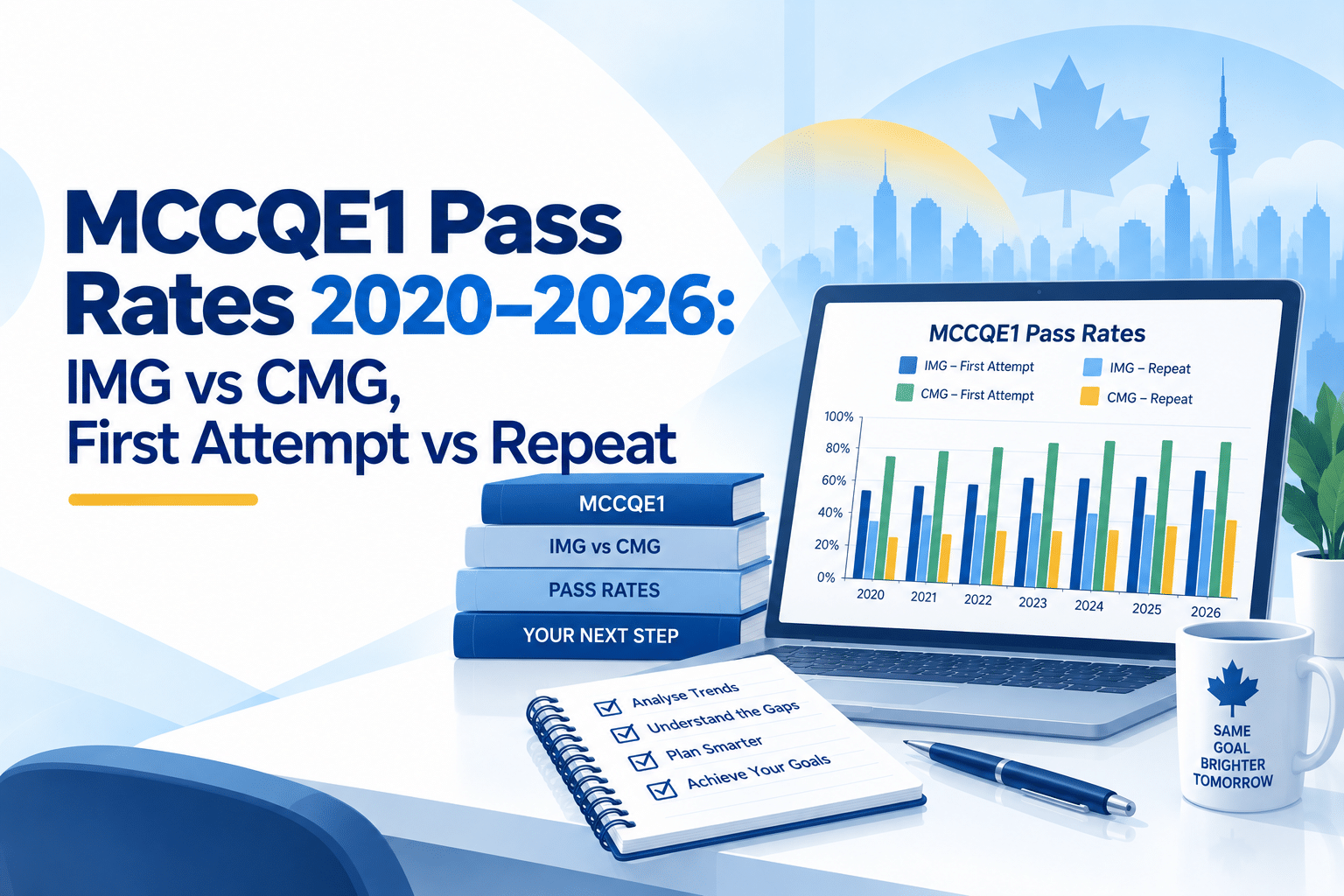
Every year, the Medical Council of Canada publishes the MCCQE1 pass rate, showing how many candidates sat the MCCQE and passed, broken down by where they trained and whether it was their first attempt. Put six years of those numbers side by side and the picture is unambiguous: the exam has become harder to pass, the change has fallen almost entirely on international medical graduates, and candidates who repeat without changing their preparation do worse than first-timers. Here are the figures, what is driving them, and what to do about it.
MCCQE1 pass rate numbers, 2020 to 2026
| Year | Candidates | Overall pass | CMG first attempt | CMG repeat | IMG first attempt | IMG repeat |
|---|---|---|---|---|---|---|
| 2020–21 | 6,729 | 77% | 98% (2,906) | 86% (86) | 64% (2,711) | 52% (1,026) |
| 2021–22 | 7,349 | 71% | 96% (2,919) | 78% (87) | 57% (3,140) | 44% (1,203) |
| 2022–23 | 7,269 | 70% | 93% (2,931) | 80% (173) | 59% (2,936) | 39% (1,229) |
| 2023–24 | 7,637 | 69% | 94% (2,979) | 79% (180) | 57% (3,266) | 40% (1,212) |
| 2024 sessions | 7,688 | 65% | 94% (2,621) | 83% (179) | 53% (3,523) | 41% (1,365) |
| 2025–26 | 10,291 | 61% | 91% (3,365) | 72% (257) | 48% (4,629) | 37% (2,040) |
Rows to 2023–24 are MCC fiscal years (April to March) from the MCCQE Part I Annual Technical Report 2024, Table 10; “2024 sessions” is the April, August and October 2024 sittings from the same report; 2025–26 is from the MCC Annual Report 2025–26 examination statistics. Numbers in brackets are test takers in each group.
Three things the table says about MCCQE1 pass rate
The overall pass rate has fallen sixteen points in five years, from 77% to 61%, while candidate numbers have risen by half. Almost all of the growth is international: IMGs made up 65% of the 2025–26 cohort, and 77% of 2024 candidates wrote the exam outside Canada, across 51 countries. The exam is now, in numbers, an IMG exam.
The fall is concentrated among IMGs. Canadian medical graduates still pass first time at 91–98%; their rate has drifted down a few points as the standard rose, but a CMG failing the MCCQE remains unusual. The IMG first-attempt rate has gone from 64% to 48% — a candidate trained abroad is now more likely than not to need a second attempt if they prepare the way the average candidate prepares.
Repeating without changing anything does not work. In every year of the series, IMGs sitting for a second or later time pass at a lower rate than first-timers, and the gap has widened: 52% versus 64% in 2020–21, 37% versus 48% in 2025–26. Repeaters are a self-selected group who found the exam hard the first time, so some of that is expected. But a 37% pass rate on a retake also means most candidates who fail go back with the same resources and the same plan for the mccqe1 pass rate.
What changed in 2025
Two decisions by the MCC explain the step down between 2024 and 2025–26 which changed the mccqe1 pass rate. From April 2025 the exam became a 230-question multiple-choice test with no clinical decision-making section. And in 2025 the MCC ran a new standard-setting exercise that replaced the 2018 pass mark (226 on a 100–400 scale) with 439 on a new 300–600 scale. The MCC’s own report on that exercise shows the new standard raised the overall failure rate from roughly 24% to 31% on the same candidates. A higher bar applied to a cohort that was already passing at lower rates produced the 48% you see above. On April 1, 2026 the exam was renamed from “MCCQE Part I” to “MCCQE”; nothing about the format or standard changed with the name.
Why IMGs fail the MCCQE1 pass rate, specifically
The blueprint has not changed in ways that should surprise anyone, so the explanation is in preparation. Four patterns come up repeatedly in the score reports we review with candidates.
The first is Canadian practice. Screening intervals, immunisation schedules, first-line drugs and referral thresholds follow Canadian guidelines, and candidates who prepared on American or British resources lose marks on questions where the “right” answer differs by country. The second is the weight of population health, epidemiology, ethics, law and professionalism — domains that most international curricula and most foreign question banks treat lightly, and which the MCCQE tests heavily. The third is language and pacing: two 115-question sections, each with its own clock, reward candidates who read Canadian-style clinical vignettes quickly, and penalise those working in a second language who have not practised at speed. The fourth is repeating the same plan: candidates who fail, reread the same notes and sit again are the 37%.
How to be on the right side of the numbers
The candidates who pass first time, in our experience, have done three things. They have answered well over a thousand exam-style questions with explanations written to Canadian guidelines, in timed conditions, and have used domain-level analytics to spend the last month on their weakest two or three domains rather than on everything. They have studied the public health and ethics content as a subject in its own right — mccQbank’s 129-question Public Health, Ethics and Epidemiology module exists because this is where IMG marks go missing. And they have measured themselves against an official form before booking: the MCC’s $1 Preparatory Examination is scored on the real scale and is the only calibration you can buy.
If you have already had a result below 439, the relevant number is not 48% — it is 37%, and the way to beat it is to treat the retake as a new preparation. Our 90-day retake plan walks through reading the score report, choosing the 2027 session and rebuilding domain by domain.
mccQbank’s question bank has 2,400+ bilingual MCQs (English and Canadian French) with domain analytics, timed and tutor modes, a one-attempt 90-question assessment and weekly updates against Canadian guidelines. Start with 30 free questions or see plans.
Sources: MCC, MCCQE Part I Annual Technical Report 2024 (Table 10); MCC Annual Report 2025–26; MCCQE Part I Standard-setting Report 2025; MCC news releases on the April 2025 format change and the April 1, 2026 name change. Figures as published in September 2026.