By Dr. Bilal Akil, MD – Emergency Medicine, Schulich School of Medicine & Dentistry, Western University · founder of mccQbank
Short answer: Practice Ready Assessment by province is an accelerated route to licensure for internationally trained physicians who have completed postgraduate training and practised independently outside Canada. There is no single national PRA; each province runs its own program with different eligibility, exam and return-of-service requirements. Most programs focus on family medicine and involve supervised practice before provisional licensure. Successful candidates typically complete a return-of-service commitment in a high-need community.
If you trained and practised as a family physician outside Canada, residency through CaRMS is not your only way in. Most provinces run a Practice Ready Assessment (PRA): a supervised assessment in a Canadian practice, usually about three months, followed by a provisional licence and a contract to work where the province needs you.
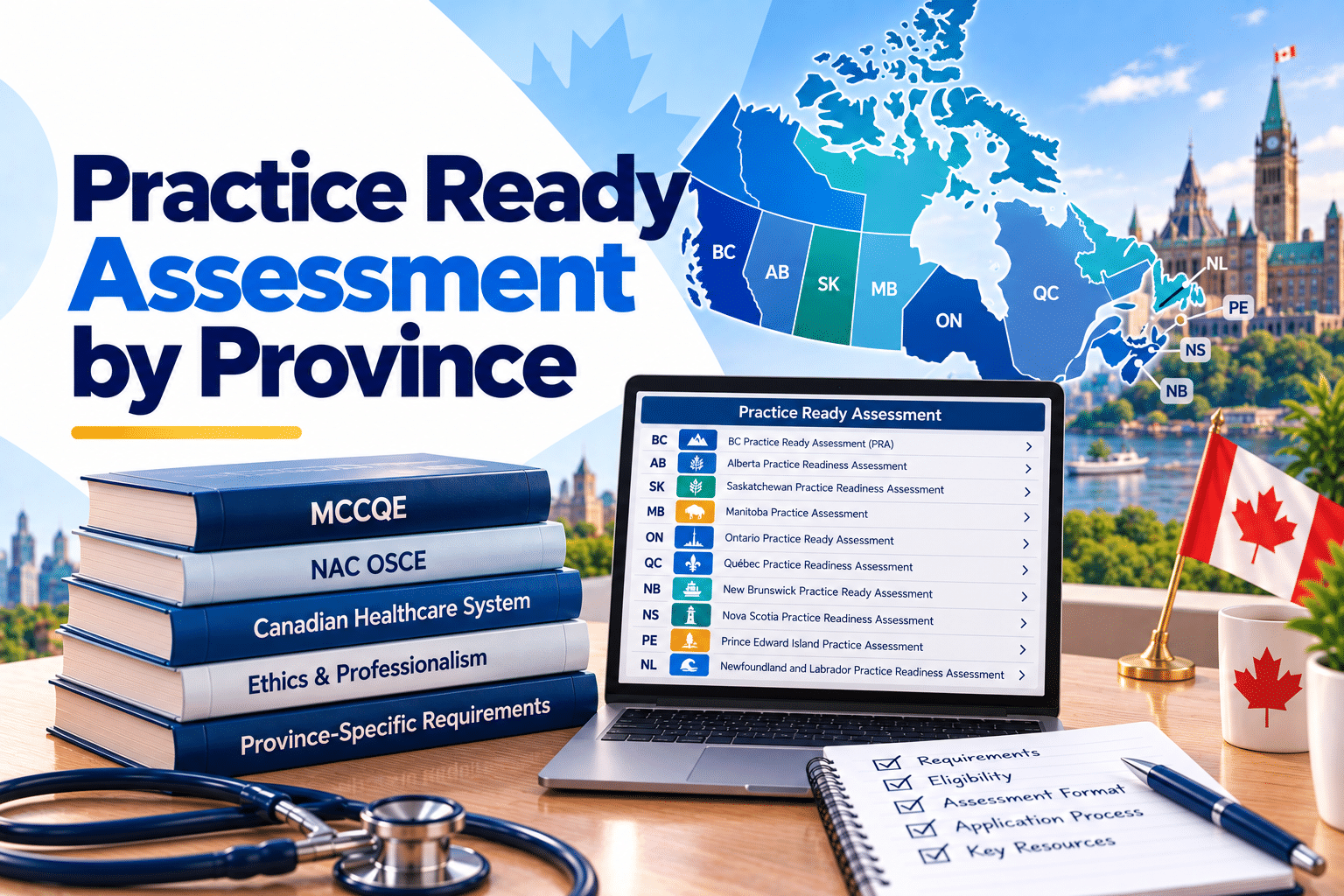
The catch is that there is no national PRA. There are just practice ready assessment by province, each with its own intake rules, exam list and service contract. This post puts them side by side, using only what each program publishes itself.
What is Practice Ready Assessment by province, according to the MCC?
The Medical Council of Canada describes practice ready assessment by province (PRA) as “an accelerated route to licensure for internationally trained physicians” who have finished postgraduate training and practised independently outside Canada. Its Practice-Ready Assessment page lists nine provincial programs. Most assess family medicine only, and the MCC states that successful participants “enter a return of service agreement to work in areas of high need within the province.”
Three points from the MCC’s PRA information for applicants shape everything below:
- You apply to the provincial program directly, not to the MCC.
- “Most” programs use the MCCQE as a screening requirement, “some” use the NAC, and “most” require a pass on the Therapeutics Decision-Making (TDM) examination.
- Each program can accept or decline any training. Meeting the published criteria gets you considered; it does not get you a place.
Practice Ready Assessment by Province-by-Province Comparison
Every cell comes from the program’s own page, checked on 23 September 2026. Where the program does not publish something, the table says “not confirmed”. Please don’t read that as “not required”.
| Province | Program | Who it assesses | MCCQE | NAC (or old MCCQE Part II) | TDM | Return of service |
|---|---|---|---|---|---|---|
| British Columbia | PRA-BC | Family medicine | Not confirmed | Not confirmed | Pass within previous 3 years, required for referral | 3 years, rural or Primary Care Network communities |
| Alberta | PRA-AB (CPSA), sponsor required | Physicians seeking the Provisional Register | Not confirmed | Not confirmed | Required for family medicine (exemptions exist) | Not confirmed |
| Saskatchewan | SIPPA | Family medicine | Required | Required | Pass within 3 years before review | 3 years, rural community assigned by the SHA |
| Manitoba | PRA MB – Family Practice | Family medicine (a specialty stream also exists) | Required | Required | Required | 4 years in underserviced areas (2025 package) |
| Ontario | Practice Ready Ontario (PRO) | Family medicine | Required (through LMCC) | Required | Required | 3 years, with Ontario’s ministry of health |
| Quebec | CMQ restrictive permit – PRA/ECE | Specialist certification in a targeted discipline; family medicine not confirmed | One of MCCQE, MCCEE (before 2019) or USMLE Step 2 CK | Not listed | Not listed | Not confirmed; permit is institutional practice only, renewed yearly |
| New Brunswick | PRA-NB | Family medicine (English or French) | Required | Preferred | Selection step unless already passed | Not yet published |
| Nova Scotia | PACE | Office-based primary care; hospitalist | Considered favourably, not mandatory | Considered favourably, not mandatory | Considered favourably, not mandatory | 3 years in Nova Scotia |
| Newfoundland and Labrador | PRA-NL | Family medicine | Required | Required | Required | Not confirmed |
Prince Edward Island and the territories do not appear on the MCC’s list of PRA programs.
Eligibility highlights, program by program
British Columbia. PRA-BC’s prescreening requirements ask for two years of postgraduate training covering seven core rotations, at least two years of independent general or family practice, and 960 hours of practice in the preceding three years. Since 17 April 2026 every applicant needs an English test (IELTS Academic 7, OET Medicine B or CELPIP General 9 in each component), and waivers are no longer accepted. The province’s PRA-BC return of service page lists up to 96 positions a year. It also calls the contract “a legal commitment that warrants independent legal advice.”
Alberta. The CPSA runs the Practice Readiness Assessment in two three-month parts. You need a sponsor before you start.
Saskatchewan. SIPPA takes no direct applications; you are prescreened through Health Careers Saskatchewan first. For the January 2027 intake (cut-off 25 September 2026), the practice-currency bar rises from three months to six months of full-time family medicine within the last three years.
Manitoba. The most recent package we could find is the 2025 one. It asked for three years of independent general or family practice within the five years before the deadline, and gave preference to Manitoba residents. Check the current package before relying on those figures.
Ontario. Practice Ready Ontario’s requirements are the most specific in the country. You must be a Canadian citizen or permanent resident and hold the LMCC, or have applied for it after passing the qualifying exam. You also need 48 months of combined postgraduate training and independent practice, with 960 hours in the last three years, at least 720 of them in person.
New Brunswick. You need either two years of postgraduate training plus one year of practice, or one year of training plus two years of practice. Currency is 450 hours in three years. You are ineligible if you have more than one failed Canadian PRA attempt in the past five years.
Nova Scotia. PACE is the outlier. It states that candidates “are never required to complete a point in time examination”, and it assesses during real patient care, typically over 12 weeks and at most 20.
Newfoundland and Labrador. PRA-NL wants a CPSNL letter confirming provisional-licence eligibility in family medicine before you apply. It turns away anyone with two or more failed PRA attempts.
The exam stack that clears the most doors
Read the exam columns together and a pattern appears. For every family-medicine program that publishes its exam rules (Saskatchewan, Manitoba, Ontario, New Brunswick and Newfoundland and Labrador), three results cover the screen:
- A pass on the MCCQE.
- A pass on the NAC examination (or an old MCCQE Part II).
- A pass on the TDM, and recent enough. BC and Saskatchewan both look back three years.
If you want to keep more than one province open, which most candidates should because places are limited and selection is competitive, work toward all three. Plan the TDM last so its three-year clock starts as late as possible. The MCC now lets you apply for the TDM directly, with no PRA program sign-off, but it caps you at four attempts in total. We covered the exam itself in our TDM guide.
On the NAC: several programs still accept “MCCQE Part II” as an alternative, which only matters if you sat it before it was retired. For how that changed, see what replaced the MCCQE Part II.
Reading a return-of-service contract
Every program that publishes a length asks for three years, except Manitoba, whose 2025 package said four. The province also decides where you go, usually a rural or underserviced community. In Ontario, you cannot complete your field assessment and your return of service at the same site with the same assessor. BC warns of significant financial consequences if you do not complete it. Before you sign, find out:
- whether the clock starts at your licence date or your first day in the community;
- what you would repay if you leave early;
- whether you can transfer to another community partway through.
Programs that do not yet publish their terms (New Brunswick says details are coming) will give them to you at selection. Get them in writing.
Where to start this month for Practice Ready Assessment by Province
- Open your physiciansapply.ca account and start source verification. The MCC lists it as a general PRA requirement, and it is the step you cannot hurry by studying.
- Book the exam you are missing, starting with the MCCQE. Check how long an MCCQE result stays valid before you time it against a PRA intake.
- Pick two provinces and read their pages yourself. These programs change their rules often. Saskatchewan changed its currency rule this year, and BC changed its language rule.
The MCCQE is the part you control most directly. When you’re ready to see where you stand, try 30 free questions.
This article summarizes published program requirements as of 23 September 2026. It is not licensing advice. Each provincial program and college is the authority on its own rules.