By Dr. Bilal Akil, MD — Emergency Medicine, Schulich School of Medicine & Dentistry, Western University · founder of mccQbank
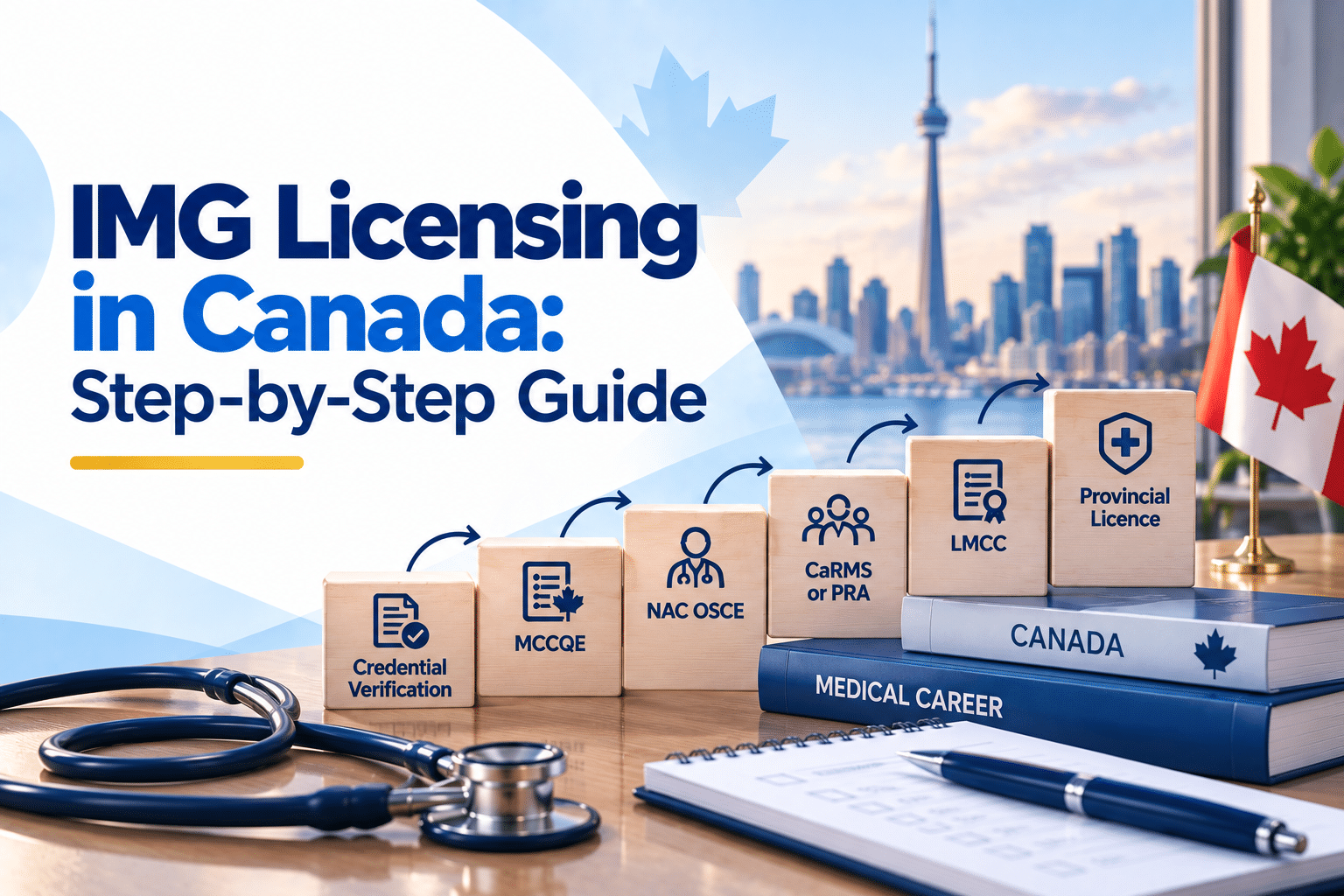
Short answer: IMG licensing in Canada follows this order for an international medical graduate (IMG):
- Show you can work in English or French.
- Open a physiciansapply.ca account and have your medical credentials source-verified.
- Pass the MCCQE (and usually the NAC examination).
- Complete training or an assessment: residency through CaRMS, or a provincial Practice Ready Assessment (PRA) if you’re already an experienced physician.
- Get the Licentiate of the Medical Council of Canada (LMCC).
- Register with the medical regulator in your province.
Those are the steps the Medical Council of Canada lays out (MCC: pathways for IMGs). This guide takes them one at a time, with the costs and the choices that matter. Checked against mcc.ca and carms.ca on 24 September 2026.
Step 1: Language Requirements for IMG Licensing in Canada
For IMG licensing in Canada, the MCC’s first point is that “all practising physicians in Canada need to be able to communicate clearly with their patients in English or French.” Each provincial regulator and many training programs set their own proof-of-language rules. Check the rules for the province you’re aiming for early, and leave time to book a test if you need one.
Step 2: Physiciansapply.ca and source verification
Everything with the MCC runs through physiciansapply.ca. For IMG licensing in Canada, the account costs $150 CAD once. Source verification, where the MCC confirms your degree directly with your school, costs $232 per credential (MCC fees). Your school must be listed in the World Directory of Medical Schools with a Canada Sponsor Note (MCC eligibility). Verification can take a while, so start it before you book any exam.
Step 3: The Exams for IMG Licensing in Canada
| Exam | What it is | Fee (CAD) | Who needs it |
|---|---|---|---|
| MCCQE | 230 multiple-choice questions, two sections, Prometric centres in Canada and over 70 countries, four sessions a year | $1,500 | Everyone, for the LMCC. Most PRA programs also screen with it. |
| NAC examination | OSCE with 12 stations (10 scored), twice a year | $3,320 | IMGs applying to residency through CaRMS; some PRA programs |
| TDM examination | Therapeutics Decision-Making | $2,850 | Most PRA programs |
Fees from mcc.ca/fees. The MCCQE pass score is 439 on a 300–600 scale. You can take it up to four times, with a one-year wait before the fourth attempt. More on the exam in how long is the MCCQE and the passing score.
Step 4: Residency or Practice Ready Assessment
This is where IMG paths split.
Residency through CaRMS is the usual path for IMG licensing in Canada, especially for recent graduates. For the R-1 match, every province requires the NAC. Almost every province also requires the MCCQE; Saskatchewan accepts USMLE Steps 1, 2 and 3 instead, and Nova Scotia/New Brunswick/PEI accept USMLE Steps 1 and 2 (CaRMS: MCC exam requirements). You must be a Canadian citizen or permanent resident to apply (CaRMS eligibility).
How recently you graduated matters. In the 2026 match, IMGs applying in their graduation year matched at 80.6% in the first iteration. IMGs who graduated in earlier years matched at 47.8% (CaRMS 2026 match data).
Practice Ready Assessment (PRA) is for physicians who have completed postgraduate training and practised independently outside Canada, hold certification from another jurisdiction, and live in Canada. Most provincial PRA programs screen with the MCCQE and require the TDM; some also use the NAC (MCC: PRA). Programs differ by province; our TDM guide covers that exam.
Step 5: The LMCC
Since 26 January 2026, the LMCC has four conditions (MCC: LMCC):
- A degree from an acceptable medical school.
- A pass on the MCCQE.
- Your medical credentials, including the degree, source-verified through the MCC.
- The LMCC fee paid, with nothing else owing to the MCC.
Provincial regulators use the LMCC as part of their requirements for a licence. We explain it fully in what the LMCC is.
Step 6: Provincial Registration for International Medical Graduates
The licence itself comes from the medical regulatory authority of the province or territory where you’ll practise, not from the MCC. Each sets its own rules on top of the LMCC, so check theirs before you commit to a province.
Where most IMGs lose time
- Starting source verification late. It runs in the background; start it first.
- Treating the NAC as an afterthought. It runs only twice a year, and you can’t sit it in consecutive sessions, so one fail can cost a year.
- Studying only clinical medicine. The MCCQE also tests Canadian ethics and law, population health and the CanMEDS roles, which foreign curricula often don’t cover.
- Applying years after graduating. The CaRMS data above shows how much that costs.
Frequently Asked Questions About IMG Licensing in Canada
How can a foreign doctor practise medicine in Canada?
Through source verification, the MCCQE (and usually the NAC), then residency through CaRMS or a provincial Practice Ready Assessment. After that come the LMCC and registration with the provincial regulator.
Can I skip residency if I’m already a specialist?
Possibly, through a provincial Practice Ready Assessment. It’s for physicians who have completed postgraduate training and practised independently abroad. Most PRA programs require the MCCQE and the TDM.
How much does it cost?
MCC fees alone: $150 for the account, $232 per verified credential, $1,500 for the MCCQE and $3,320 for the NAC. Add $2,850 for the TDM if you go the PRA route. Provincial registration and program fees are extra.
Does the USMLE count in Canada?
Only as a substitute for the MCCQE for the CaRMS match: Saskatchewan accepts USMLE Steps 1, 2 and 3, and Nova Scotia/New Brunswick/PEI accept Steps 1 and 2. The NAC is still required.
Can I write the exams from outside Canada?
The MCCQE, yes: it’s offered at Prometric centres in Canada and over 70 countries. The NAC is held at designated centres; check the MCC’s NAC page for locations.
Starting the MCCQE? Try 30 free MCCQE questions, in English or French.