3.25.58 PM.png)
.png)
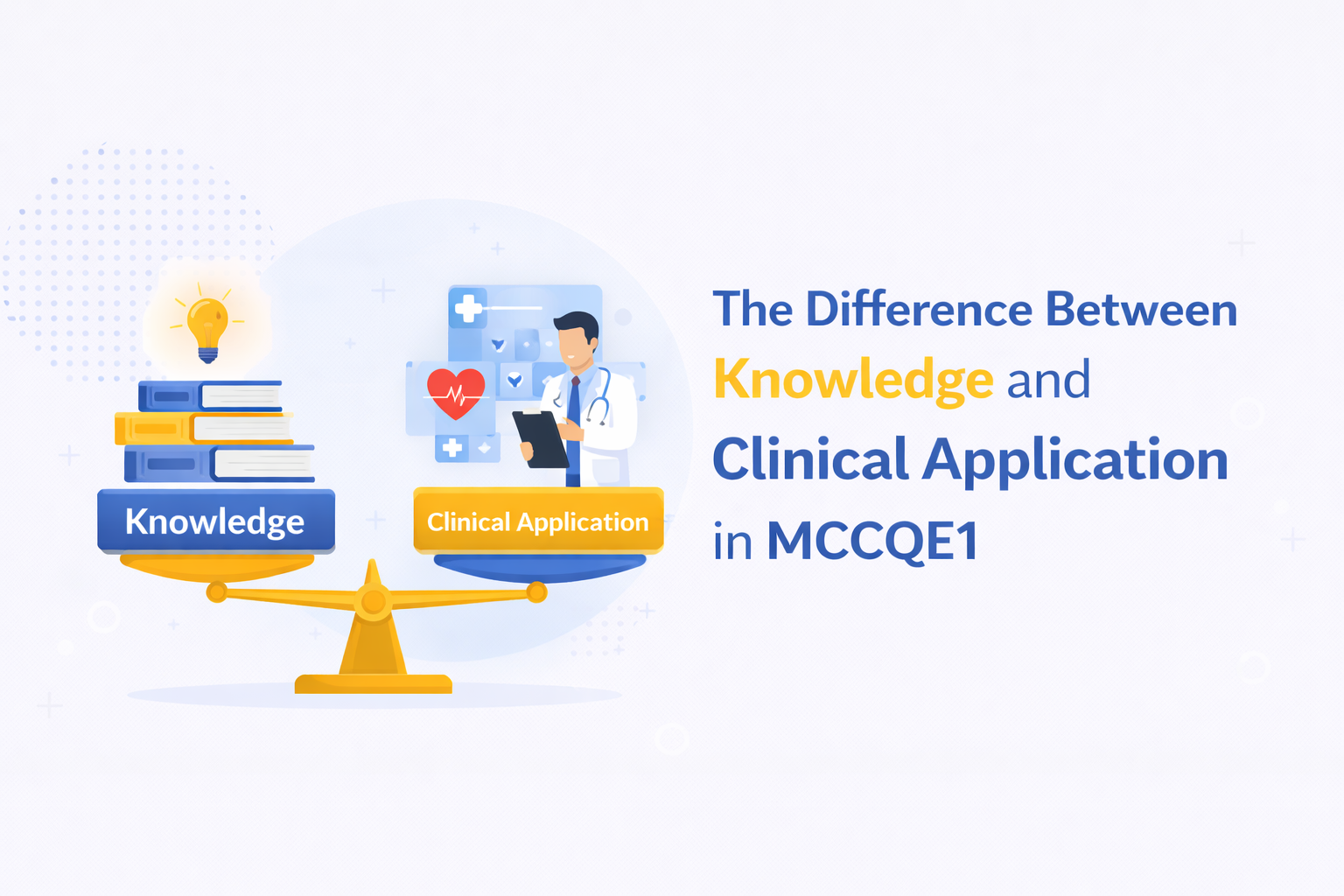
Preparing for the MCCQE1 requires more than simply memorising medical facts. While a strong foundation of medical knowledge is essential, the exam primarily evaluates a candidate’s ability to apply that knowledge in clinical situations. Understanding the difference between knowing information and using it effectively in patient care is key to performing well on the MCCQE1.
Many candidates realise during their preparation that success in this exam depends not only on what they know, but also on how they use that knowledge to make clinical decisions.
Medical Knowledge: The Foundation of Preparation
Medical knowledge refers to understanding core concepts such as disease mechanisms, diagnostic criteria, treatment options, and clinical guidelines. This knowledge forms the foundation of medical practice and is essential for answering clinical questions.
For example, a candidate may know the diagnostic features of common conditions, the indications for specific investigations, or the standard treatment approaches for various diseases. Building this knowledge base is an important early step in MCCQE1 preparation.
However, the exam rarely tests simple recall of facts. Instead, it focuses on how well candidates can apply their knowledge to solve clinical problems.
Clinical Application: Applying Knowledge to Patient Scenarios
The MCCQE1 exam presents clinical cases that require candidates to analyse patient information and choose the most appropriate next step. These questions often involve multiple pieces of information, such as symptoms, examination findings, and investigation results.
Candidates must interpret these details and determine what action should be taken next. This may involve selecting the most appropriate test, identifying the likely diagnosis, or choosing the correct management plan.
Clinical application therefore requires candidates to integrate knowledge with reasoning and decision-making, which is a critical skill for practising physicians.
Why Clinical Reasoning Matters in MCCQE1
Many students preparing for the MCCQE1 discover that simply reading textbooks is not enough to develop strong clinical reasoning skills. The ability to apply knowledge improves through practice with clinical scenarios and case-based questions.
By repeatedly analysing patient cases, candidates learn how to approach clinical problems systematically. This process strengthens diagnostic thinking and improves confidence in selecting the best management options.
Practising exam-style questions also helps candidates become familiar with the structure and complexity of MCCQE1 questions.
Strengthening Clinical Application with mccQbank
Developing clinical reasoning requires consistent practice with realistic patient scenarios. mccQbank provides case-based questions designed to reflect the style and reasoning required in the MCCQE1, helping candidates practise applying their medical knowledge in clinical contexts.
By combining foundational knowledge with regular question-based practice, candidates can improve both their understanding and their ability to make clinical decisions. This balanced approach helps students prepare more effectively and approach the MCCQE1 with greater confidence.