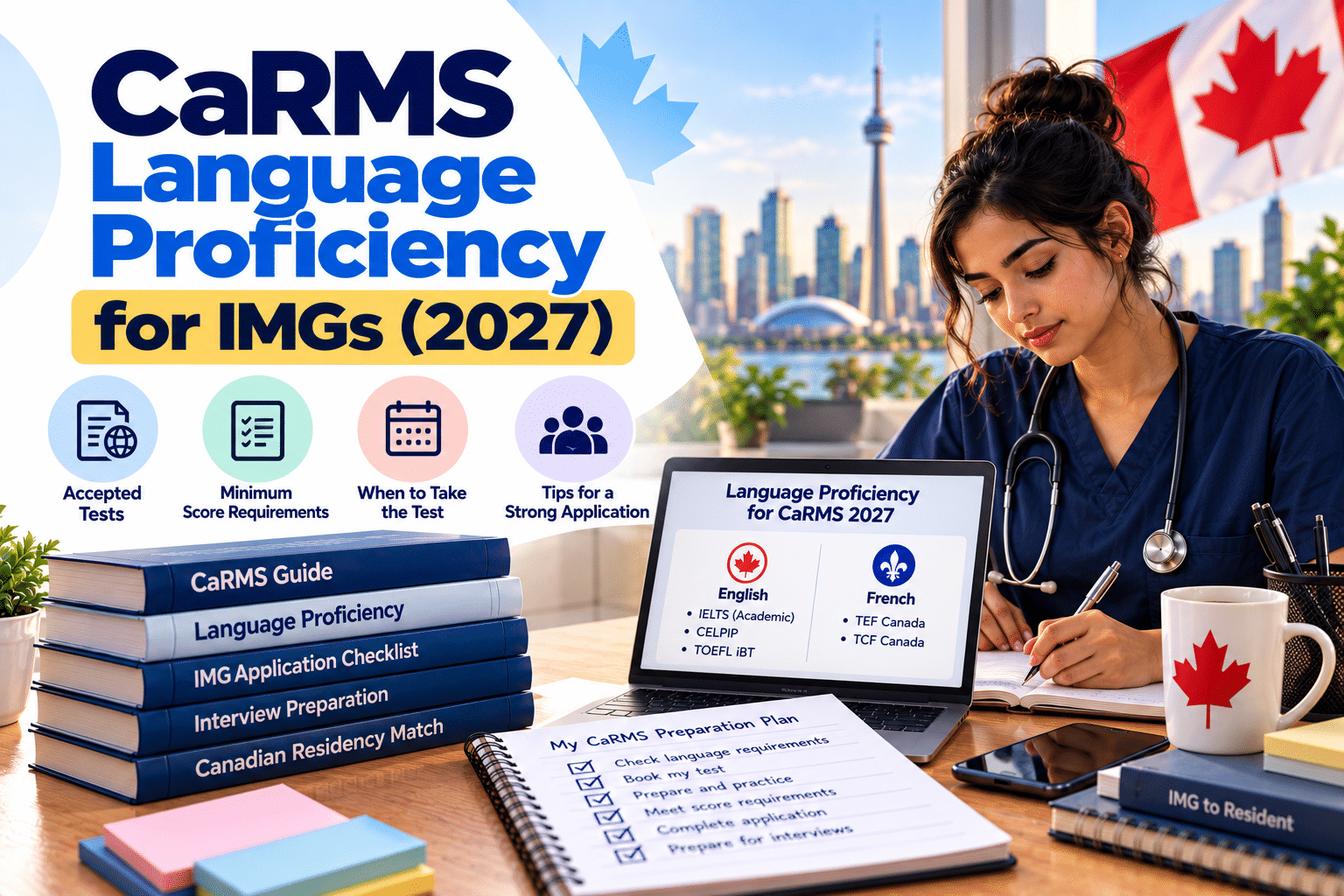
Short answer: CaRMS requires proof of language proficiency from international medical graduates (IMGs) unless they meet its exemption. The exemption covers IMGs who completed their basic medical education and patient care experience in one of 23 listed countries, and it applies only to programs in Alberta, British Columbia, Newfoundland and Labrador, Nova Scotia, New Brunswick, PEI, Manitoba and Saskatchewan. Ontario accepts a wider range of proof, and Quebec sends you to each program’s description. Language exam results must be valid until 1 July 2027, and everything must be submitted and assigned to programs by the application deadline, 26 November 2026 at 12:00 noon ET.
By Dr. Bilal Akil, MD — Emergency Medicine, Schulich School of Medicine & Dentistry, Western University · founder of mccQbank
Unless noted, everything below comes from the CaRMS R-1 summary of language proficiency requirements, read on 12 October 2026. One caution first: CaRMS states that the criteria on that page “is from the 2026 match” and that updated 2027 provincial criteria will be posted once each province has reviewed them. Check the page again before you book or pay for a test.
CaRMS Language Proficiency Requirements for IMGs
CaRMS lists proof of language proficiency as one of the potential additional requirements, alongside the Casper test and the Family Medicine Professional Choices Assessment. It sits on top of the basic eligibility rules, such as citizenship and the MCC examination requirements. If you are still mapping the whole cycle, our CaRMS 2027 timeline for IMGs lists every first-iteration date.
The rule depends mainly on whether CaRMS treats you as a Canadian medical graduate (CMG) or an IMG, on where you trained (for CMGs, your school’s language of instruction), and on which provinces you apply to. The page does not mention citizenship.
Who counts as an IMG for this rule
Graduates of medical schools outside Canada apply as IMGs. The page adds one change that catches people out: graduates of U.S. allopathic (MD) schools who graduated on or after 1 July 2025 are IMGs, while those who graduated before that date are CMGs. CaRMS describes a narrow exception for combined-degree students (such as MD-PhD) at LCME-accredited schools: those who began the MD component on or before 31 December 2020 and complete the combined program before 30 June 2028 are considered CMGs, with an official transcript as proof. Read the page itself if that might be you.
CMGs mostly do not need a test. Graduates of Canadian schools taught in English need no proof anywhere outside Quebec. Graduates of Canadian schools taught in French need proof in Newfoundland and Labrador, the Maritimes, Saskatchewan, Alberta and British Columbia, but not in Ontario or Manitoba. Quebec programs set their own requirements in their program descriptions.
CaRMS Language Proficiency: The 23-Country Exemption
CaRMS says proof of language proficiency is not required for IMGs applying to programs in Alberta, British Columbia, Newfoundland and Labrador, Nova Scotia, New Brunswick and PEI, Manitoba and Saskatchewan if they completed their basic medical education and patient care experience in one of these countries:
Australia, Bahamas, Bermuda, British Virgin Islands, Canada, Ireland, New Zealand, Singapore, South Africa, United Kingdom, United States, U.S. Virgin Islands, Anguilla, Antigua and Barbuda, Barbados, Dominica, Grenada, Grenadines, Jamaica, St. Kitts and Nevis, St. Lucia, St. Vincent, and Trinidad and Tobago.
Three things to notice. First, Ontario and Quebec are not in the exemption sentence. Second, the condition covers both your basic medical education and your patient care experience, not your degree alone. Third, the page does not say how it treats someone whose classroom years and clinical training were in two different listed countries, as happens with some Caribbean schools. If that is your situation, ask CaRMS (help@carms.ca) in writing before you decide you are exempt. Everyone who does not meet the exemption needs proof.
Accepted CaRMS Language Proficiency Tests by Province
This is the IMG table from the CaRMS page, rearranged so each proof is one row. “Yes” means CaRMS marks the proof as accepted for that province group. CELPIP, IELTS and OET scores must each come from a single sitting, with one exception below.
| Proof | NL, NS, NB, PEI, MB, AB, BC | Saskatchewan | Ontario | Quebec |
|---|---|---|---|---|
| CELPIP General: at least 9 in each of the four skills | Yes | Yes | Yes | See program descriptions |
| IELTS Academic: at least 7.0 in each of the four skills | Yes | Yes | Yes | See program descriptions |
| OET Medicine (test venue or at home): at least B in each of the four skills | Yes | Yes | Yes | See program descriptions |
| Letter from your dean attesting that your medical school program of instruction was completed solely in English | No | Yes | Yes | See program descriptions |
| TOEFL iBT (or Home Edition): at least 93 overall and 24 in speaking | No | No | Yes | See program descriptions |
| FAIMER World Directory printout or PDF of your school’s Program Details page | No | No | Yes | See program descriptions |
| French tests (TCF, TCF Canada, TCF Québec, TEF, Examen de l’OQLF, TFI) | No | No | No | See program descriptions |
One exception to the same-sitting rule: for Newfoundland and Labrador, CaRMS allows the minimum scores to be achieved across a maximum of two combined sittings of the same test.
A decision rule you can apply in five minutes
- Step 1. Settle your status. Non-Canadian school, or a U.S. MD school with graduation on or after 1 July 2025: you apply as an IMG.
- Step 2. List your provinces. Write down every province you will apply to, including the ones you are only considering.
- Step 3. Test the exemption. If every province on your list is in the exemption group (AB, BC, NL, NS, NB, PEI, MB, SK) and your basic medical education and patient care experience were in a listed country, you need no proof for those programs.
- Step 4. Ontario only? Ontario accepts any of six proofs, including a dean’s letter or the FAIMER page. Check that your school’s FAIMER entry or your dean can confirm English-language instruction.
- Step 5. Ontario plus anywhere else, or no exemption? Take CELPIP General, IELTS Academic or OET Medicine. They are the only proofs the CaRMS chart marks as accepted in every non-Quebec column. The chart marks a dean’s letter as accepted only in Saskatchewan and Ontario, and TOEFL and the FAIMER page only in Ontario.
- Step 6. Quebec on your list? Read each Quebec program’s description; CaRMS does not summarize their rules.
The mistake this rule is built to prevent: an IMG applying across several provinces with a TOEFL score or a dean’s letter, which the chart accepts in Ontario (and, for the dean’s letter, Saskatchewan) but not in the other non-Quebec provinces.
CaRMS Language Proficiency Deadlines and Validity
Two dates matter. Your result must be valid until 1 July 2027, and it must be submitted by the application deadline. On the CaRMS first-iteration applicant timeline, that deadline is 26 November 2026 at 12:00 (noon) ET for submitting and assigning applications and all required documents. File review begins at 12:05 ET the same day.
| Date (2026) | What it means for language proof |
|---|---|
| Now (mid-October) | Decide whether you need proof. If you need a test and do not have a valid result, book it and compare the provider’s published results time with 26 November. |
| Before 26 November | Upload the result or document in CaRMS Online and assign it to every program that needs it. |
| 26 November, 12:00 noon ET | Applications and all required documents must be submitted and assigned. |
| 1 July 2027 | Your result must still be valid on this date. Check the expiry printed on your test report. |
CaRMS Online has a Language Proficiency section under My Information, and the CaRMS help centre has articles on entering OET results and on assigning the FAIMER page, both linked from the language summary page.
How this fits the rest of your Canadian plan
The CaRMS rule is for the R-1 match only. Other routes set their own language rules; Practice Ready Assessment programs are one example, covered province by province in our Practice Ready Assessment guide. For the full sequence of exams, credential verification and the match, see how an IMG gets licensed in Canada, and if the NAC is still ahead of you, start with NAC eligibility and how to apply.
While you sort out documents, keep your MCCQE preparation moving. mccQbank has 2,400+ bilingual, case-based questions with explanations. Try 30 free questions.
Frequently asked questions
Do Canadian citizens who studied medicine abroad need a language test?
The CaRMS page does not mention citizenship. The exemption depends on where you completed your basic medical education and patient care experience, and on the provinces you apply to.
Can I combine IELTS scores from two attempts?
Not in general: CaRMS requires the minimum in each skill in the same sitting. The exception is Newfoundland and Labrador, which accepts the minimums across a maximum of two combined sittings of the same test.
Is TOEFL accepted for CaRMS?
The current summary marks TOEFL iBT as accepted only in Ontario, with at least 93 overall and 24 in speaking. For Quebec, see each program’s description.
Will a French test work outside Quebec?
No. The summary marks the French tests as not accepted in every province group except Quebec, where you follow each program’s description.
Are these the 2027 rules?
CaRMS says the page shows 2026-match criteria and will be updated with 2027 provincial criteria in the coming months. Re-check it before you book a test, and again before 26 November.