By Dr. Bilal Akil, MD — Emergency Medicine, Schulich School of Medicine & Dentistry, Western University · founder of mccQbank
The NAC Examination is the clinical exam that stands between most international medical graduates and a CaRMS application. It is easy to lose a session on paperwork: the application window for each session is only three weeks long, and an IMG cannot submit it at all until one specific document request is in. This guide covers NAC exam eligibility, how the application works on physiciansapply.ca, and how to plan backwards from the session you want. Every rule below comes from the Medical Council of Canada (MCC) pages linked in each section, read on 3 October 2026 and re-checked on 4 October 2026.
Short answer: For NAC exam eligibility, you must have graduated, or expect to complete all degree requirements within 15 months of the exam date, from a medical school outside Canada listed in the World Directory of Medical Schools with a Canada Sponsor Note, a U.S. school of osteopathic medicine, or a U.S. school of allopathic medicine (only if you graduated on or after 1 July 2025) (MCC: NAC eligibility and application). You apply through your physiciansapply.ca account while a session’s application window is open, the application fee is $3,320 (MCC fees), and you can sit the exam at most three times, never in consecutive sessions (MCC: NAC eligibility and application). The MCC had not posted the 2027 session dates when we checked on 4 October 2026.
Understanding NAC Exam Eligibility
The MCC’s NAC eligibility and application page outlines three routes for meeting NAC exam eligibility. You must be a graduate of, or a student expected to finish all degree requirements within 15 months of the exam date at, one of these:
- a medical school outside Canada that is listed in the World Directory of Medical Schools with a Canada Sponsor Note marking it as acceptable in Canada;
- a U.S. School of Osteopathic Medicine; or
- a U.S. School of Allopathic Medicine, but only if you graduated on or after 1 July 2025.
A U.S. allopathic (MD) graduate from before 1 July 2025 cannot apply. CaRMS considers those graduates Canadian medical graduates.
Quick NAC Exam Eligibility Check
| Your situation | Can you apply for the NAC? |
|---|---|
| Graduated from a school abroad with a Canada Sponsor Note | Yes |
| Final-year student at that school, graduating within 15 months of the exam date | Yes, as a student (needs a Student Attestation form) |
| Student graduating more than 15 months after the exam date | Not yet: wait for a later session |
| School abroad with no Canada Sponsor Note | No |
| U.S. DO graduate | Yes |
| U.S. MD graduate, graduated on or after 1 July 2025 | Yes; contact the MCC through physiciansapply.ca first |
| U.S. MD graduate, graduated before 1 July 2025 | No |
The 15-month rule is one of the most misunderstood parts of NAC exam eligibility for final-year students. It is counted from the exam date, not from the application date. A student finishing in June 2028 is inside it for any exam held from March 2027 on, so the September 2027 session qualifies.
NAC Exam Eligibility and Attempt Rules
Beyond NAC exam eligibility, three rules on the same MCC page shape your exam plan:
- Three attempts in total. You can sit the NAC a maximum of three times, pass or fail.
- No back-to-back sessions. You cannot sit two consecutive sessions. The MCC’s example: if you took it in May 2024, your next chance is May 2025 or later. In practice a failed attempt costs you a year, not a few months.
- Your most recent result counts. Only the most recent result stays valid, and it does not expire. A retake to raise a pass replaces the old result, whatever you score.
So decide before you book whether you are ready. Because of the consecutive-session rule, sitting the exam “for practice” is expensive.
How to apply on physiciansapply.ca
Everything goes through your physiciansapply.ca account. If you don’t have one, the MCC’s fee schedule lists a one-time setup fee of $150.
If you are an international medical graduate:
- Create a source verification request (SVR) for your medical degree, if you haven’t already. You can apply for the exam as soon as the SVR is submitted and paid. You don’t have to wait for it to come back. The SVR fee is $232 per credential.
- Prepare your identity documents. Your primary ID must be certified to the MCC’s requirements.
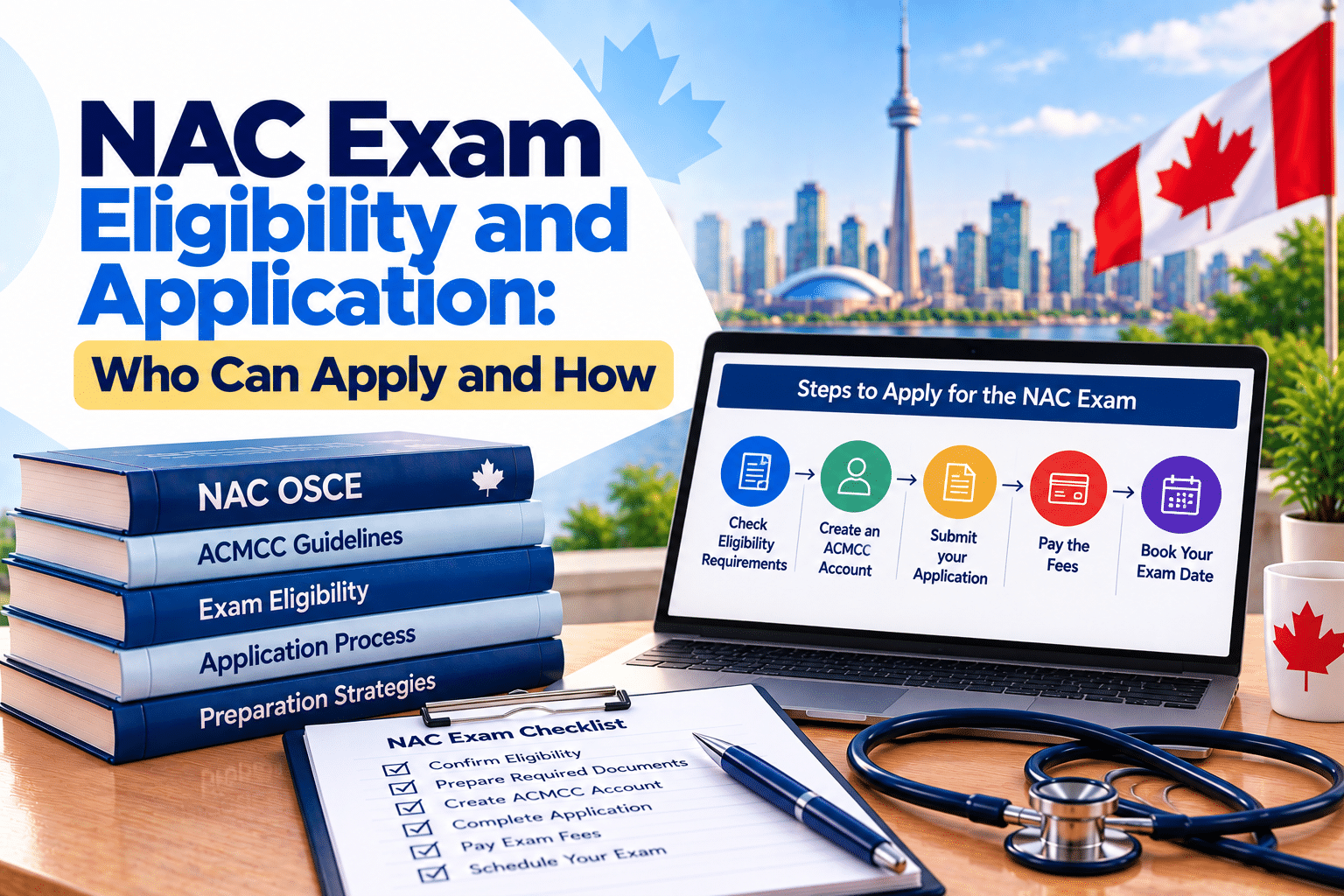
- In your account, go to Examinations, then Apply for an exam. The NAC is listed only if you are eligible and a window is open.
- Upload documents, choose up to three exam centres in order of preference, and pay the application fee.
If you are a final-year student: the MCC’s student steps have no SVR. Steps 2 to 4 are the same. Your school also completes the MCC’s Student Attestation form, which you upload with your application.
Allow up to four weeks for processing. You get a message in your account once the application is complete.
What it costs
From the MCC fee schedule (Canadian dollars):
| Item | Fee |
|---|---|
| physiciansapply.ca account setup (one time) | $150 |
| Source verification request, per medical credential | $232 |
| NAC Examination application | $3,320 |
| Withdrawal fee, if you withdraw before the withdrawal deadline | $538 (you are eligible for a refund of the rest) |
| Administration fee if absent on exam day for extenuating circumstances | $1,660 (rest may be refunded) |
The fee schedule also notes that tuition tax credits are available for the NAC with a receipt.
Deadlines: plan backwards from the session
After confirming your NAC exam eligibility, the next step is planning your session. The NAC is a half-day OSCE held twice a year, in spring and fall (typically May and September), at a limited number of centres across Canada. The MCC had not posted the 2027 dates when we checked on 4 October 2026. The 2026 cycle, from the MCC scheduling page, shows how the calendar runs:
| May 2026 session | September 2026 session | |
|---|---|---|
| Applications open | 19 Nov 2025 | 4 Mar 2026 |
| Applications close (11:59 p.m. ET) | 10 Dec 2025 | 25 Mar 2026 |
| Withdrawal with partial refund deadline | 6 Jan 2026 | 21 Apr 2026 |
| Centre choice change deadline | 20 Jan 2026 | 15 May 2026 |
| Exam | 2 May 2026 | 19–20 Sep 2026 |
| Results | End of June 2026 | Late November 2026 |
The MCC also reopened applications for the September session on 11–15 May 2026 “to meet CaRMS timelines”. Don’t count on a reopening. It isn’t guaranteed.
Three things follow from the table:
- Each window was 21 days. Miss it and the next window is months away.
- Applications closed 20 to 25 weeks before the exam. If you want a given session, your SVR and ID need to be ready about six months ahead.
- Results take about eight weeks. The MCC says results arrive about 8 weeks after the exam and advises taking the earliest session if you face a deadline.
A backwards plan
If you are aiming for a CaRMS file review, work from the results date:
- About eight weeks before you need results: the exam.
- About six months before the exam: the application window. Have your SVR submitted and paid, your certified ID ready, and (for students) the Student Attestation signed.
- Before the window opens: sign up on the MCC page to be told when applications open.
- About six weeks before the exam: your centre assignment arrives in physiciansapply.ca. About four weeks before, the Entrance Card package follows.
For how the 2027 sessions are likely to fall, see our NAC OSCE dates 2027 guide.
Choosing exam centres
You rank up to three centres. The MCC says choosing only one does not improve your chance of getting it. You also answer whether you would accept any other available centre. If you say no and none of your choices has room, your application is withdrawn and refunded minus the withdrawal fee. Once centres are assigned, you can’t change them. You don’t need to sit the exam in the province where you will apply for residency: program directors accept results from any centre.
The September 2026 centres were Edmonton, Calgary, Winnipeg, Hamilton, London, Ottawa (also in French), Toronto, Windsor and Saskatoon.
Do you need the NAC for CaRMS?
The MCC’s eligibility page says IMGs applying to the CaRMS R-1 match need results for both the MCCQE and the NAC, and that you can take them in either order. The CaRMS summary of MCC examination requirements adds one nuance for Quebec. The Collège des médecins du Québec no longer requires the NAC for MD equivalency, but Quebec’s medical schools still require it for residency admission. CaRMS also notes that its page still shows the 2026 match criteria until the 2027 provincial criteria are posted, so check it again before you apply.
If you’re deciding which exam to sit first, our MCCQE and NAC timeline guide walks through the order. Once you’re booked, the NAC OSCE station checklist covers what examiners score in each 11-minute station.
What happens after you apply
- Your application is processed (up to four weeks).
- Centre assignment comes about six weeks before the exam.
- The Entrance Card package comes about four weeks before, with your arrival time and centre details.
- On the day: 12 stations, 2 of them unscored pilots, 11 minutes each, with 2 minutes between stations (NAC overview).
- Results come about eight weeks later. Our guide to understanding NAC OSCE scores explains what they mean.
Not sure the NAC is your next step?
If you are an internationally trained physician and unsure which route to practice in Canada fits your training, the MCC announced a free Licensure Pathway Navigation Service on 24 September 2026 (MCC news). It is a one-time, one-on-one virtual consultation of about 60 minutes with a Licensure Navigation Specialist, in English or French, followed by a written summary. It is a pilot with a limited number of consultations, and to qualify you must meet criteria tied to your physiciansapply.ca account, source verification, language proficiency and postgraduate training. The MCC says decisions rest with the responsible programs and medical regulatory authorities, so treat the consultation as orientation, not approval.
NAC Exam Eligibility FAQs
Can final-year medical students take the NAC?
Yes. Final-year students meet NAC exam eligibility if they are expected to complete all their medical degree requirements within 15 months of the exam date. Your medical school completes the MCC’s Student Attestation form, which you upload with your application (MCC: NAC eligibility and application).
How many times can you take the NAC exam?
Three times at most, whether you pass or fail. You cannot sit two consecutive sessions, and only your most recent result stays valid; it does not expire (MCC: NAC eligibility and application).
How much does the NAC Examination cost?
The application fee is $3,320 (Canadian dollars). If you withdraw before the withdrawal deadline, you are eligible for a refund less a $538 withdrawal fee. A physiciansapply.ca account has a one-time $150 setup fee, and source verification costs $232 per medical credential (MCC fees).
When are the 2027 NAC exam dates?
The MCC had not posted them when we checked on 4 October 2026. The exam runs twice a year, typically in May and September; the 2026 sessions were on 2 May and on 19 and 20 September. You can sign up on the MCC NAC scheduling page to be told when applications open.
When do September 2026 NAC results come out?
The MCC lists “Late November 2026” for the September 2026 session; its general guide is that results are available about 8 weeks after the exam date (MCC NAC scheduling). That is close to the CaRMS first-iteration application deadline of 26 November 2026 at 12:00 noon ET, and CaRMS warns that some programs will not review late documents (CaRMS R-1 timeline).
Do I have to write the NAC in the province where I apply?
No. The MCC says residency program directors accept NAC results regardless of where you take the exam, so you do not need a centre in that province (MCC NAC scheduling).
Before you book
Most IMGs need an MCCQE result as well as the NAC for CaRMS. If your MCCQE preparation is still ahead of you, see where you stand before you plan both exams: try 30 free questions from the mccQbank MCCQE bank.