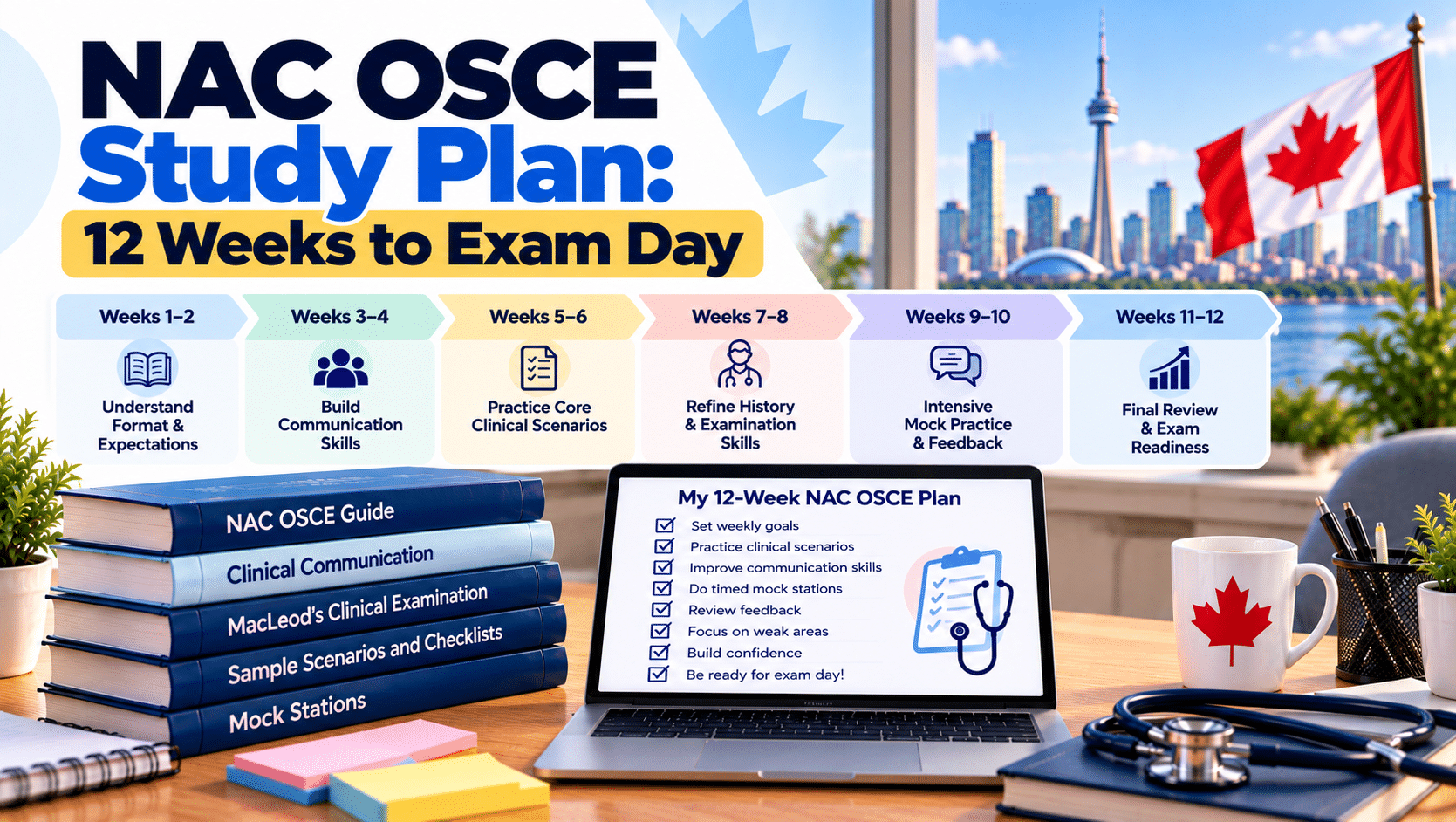
Short answer
NAC OSCE study plan prepares you for the NAC OSCE by practising whole stations out loud under the 11-minute clock, with a partner playing the patient and a second person scoring you against the seven competencies the MCC lists. Spend weeks 1–4 building station routines, weeks 5–8 on volume across all six problem areas, and weeks 9–12 on full timed circuits and your weakest subscore domain.
By Dr. Bilal Akil, MD — Emergency Medicine, Schulich School of Medicine & Dentistry, Western University · founder of mccQbank
The NAC Examination is a half-day OSCE: 12 stations of 11 minutes each, scored by physician examiners on up to seven competencies. That structure tells you how to prepare. This NAC OSCE study plan works backwards from the exam format over 12 weeks, and every exam rule in it is linked to the Medical Council of Canada (MCC).
What Your NAC OSCE Study Plan Should Cover
- Format: 12 stations, 2 of which are pilot stations that do not count. Each station is 11 minutes, with 2 minutes between stations and 2–3 wait stations (MCC NAC overview).
- Problem areas: medicine, surgery, pediatrics, obstetrics and gynecology, psychiatry, and preventive medicine and public health.
- Scoring: examiners use a checklist of tasks, an answer key to oral questions and rating scales covering up to 7 competencies: history taking, diagnosis, management, communication skills, physical examination, investigations and data interpretation (MCC NAC results page).
- Your total score is the average of your 10 scored stations, and every station is worth the same. The scale runs from 500 to 700, and the pass score is 577.
- In stations with oral questions, the examiner starts asking them at the 8-minute mark, and from then on you cannot go back to the patient (MCC NAC exam day page).
Two things follow. Every station carries equal weight, so a station in a weak specialty costs you as much as any other. And the NAC is criterion-referenced: the MCC says candidates who meet the standard pass “regardless of how well other candidates perform.” You are working towards a fixed bar, not competing with the room.
The 12-week NAC OSCE study plan
| Weeks | Focus | What you do | Competencies in focus |
|---|---|---|---|
| 1–2 | Station routines | Write and rehearse your opening, a history framework, a verbalised physical exam and a close. 10–15 untimed stations, all out loud. | History taking, physical examination, communication skills |
| 3–4 | The 11-minute clock | Time every station at 11 minutes, with a 2-minute read of the door instructions first. In half of them, have your partner switch to oral questions at minute 8. | Diagnosis, investigations, data interpretation |
| 5–6 | Breadth, part 1 | Medicine, surgery and pediatrics: history, combined history and physical, and management stations. | Diagnosis, management |
| 7–8 | Breadth, part 2 | Obstetrics and gynecology, psychiatry, and preventive medicine and public health, including counselling stations and stations with a family member. | Communication skills, management |
| 9–10 | Full circuits | One or two mock circuits a week: 10 scored stations back to back, with wait stations and one small notebook for all your notes. | All seven |
| 11 | Weakest domain | Rescore your last two circuits by the three subscore domains (below) and spend the week on the lowest. | Your lowest domain |
| 12 | Taper and logistics | Two short timed sets only. Check your Entrance Card, exam-day items and route to the centre. | — |
Score your practice the way the MCC reports it
Your Supplemental Information Report shows subscores in three domains: assessment and diagnosis, management, and communication skills (MCC NAC results page). The MCC does not publish which competency feeds which domain, so the grouping below is ours, based on the domain names. The “what to check” column paraphrases the MCC’s own competency descriptions on the NAC overview page.
| Domain | Competencies (our grouping) | What your scoring partner checks |
|---|---|---|
| Assessment and diagnosis | History taking, physical examination, investigations, data interpretation, diagnosis | A chronological, medically logical history (onset, location, duration, character, severity); an efficient, logical exam that explains each action and respects comfort and modesty; suitable tests with risks and benefits considered; results read in context; a reasonable differential |
| Management | Management | Treatment, monitoring, counselling and follow-up; risks and benefits explained; prevention and health promotion where relevant; medication classes unless specific drugs and dosages would reasonably be expected |
| Communication skills | Communication skills | Trust and respect established; clear information without jargon; understanding confirmed with repetition and summarizing; appropriate eye contact, posture and use of silence |
When to Add Full Mock Circuits to Your NAC OSCE Study Plan
This is our rule of thumb, not an MCC requirement:
- Stay on single stations while you still reach minute 8 with history or examination unfinished.
- Move to full circuits once three timed sets in a row end on time, with every competency the station called for attempted.
- After each circuit, spend the next two practice days on the lowest-scoring domain.
- If you miss that bar two weeks running, add weeks to the middle of the plan. Don’t cut week 12.
Practise without a simulation centre
Start with the MCC’s free NAC Examination resources: two videos (“Navigating an OSCE” and “Communicating with SPs”) and sample cases written as they are given to standardized participants. The MCC says the cases can be used for role-play practice with peers. For solo routines and partner drills, see our guide to practising NAC OSCE cases at home. For what to do in each phase of a station, use the NAC OSCE station checklist.
Rehearse the exam-day rules as well as the medicine (MCC NAC exam day page):
- You get one small notebook, and your notes in it are not scored.
- In physical exam stations you tell the examiner which manoeuvres you are doing, what you are looking for and what you find.
- You do not perform genital, rectal, vaginal, breast, reflex or other sensitive examinations. If one is needed, you tell the examiner.
- In a combined history and physical or a management station, deciding what to do first is up to you.
The content itself is built from the MCC Examination Objectives, which the MCC uses to write questions for both the MCCQE and the NAC. They are the best checklist of presentations to cover in weeks 5–8.
How to Schedule Your NAC OSCE Study Plan Around Exam Dates
The NAC runs twice a year, typically in May and September (MCC NAC scheduling page). Applications close months before the exam. For the September 2026 session, applications ran from 4 to 25 March 2026 and reopened from 11 to 15 May 2026, the exam was on 19 and 20 September, and results are due in late November 2026. Results arrive about 8 weeks after the exam. The next session is Saturday 1 May 2027: applications open on 18 November and close on 9 December 2026, and results are due in late June 2027 (MCC scheduling page, checked 19 October 2026).
Counting back 12 weeks from a mid-September exam puts the start of your NAC OSCE study plan in late June; for the 1 May 2027 exam, it puts your start on 6 February 2027. Apply first: the NAC eligibility and application guide covers who can apply and how.
Plan as if this is your only attempt. The MCC allows a maximum of 3 attempts, and the exam cannot be taken in consecutive sessions. With two sessions a year, a failed attempt means waiting at least a year to retake. Only your most recent result remains valid.
Frequently asked questions
How long should I prepare for the NAC OSCE?
This NAC OSCE study plan uses 12 weeks. The MCC does not publish a recommended preparation time, so add weeks if you are working full time or are new to OSCEs.
Can I prepare for the NAC OSCE alone?
You can build routines alone, but scoring needs other people. The MCC says its sample cases can be used for role-play practice with peers.
What score do I need to pass the NAC?
577, on a scale of 500 to 700 (MCC NAC results page).
Do I have to write the NAC in the province where I apply?
No. Residency program directors accept results regardless of where you took the exam (MCC NAC scheduling page).
For timed station practice, mccQbank’s NAC OSCE preparation with OSCE-R has history and physical-exam stations timed like the real exam.