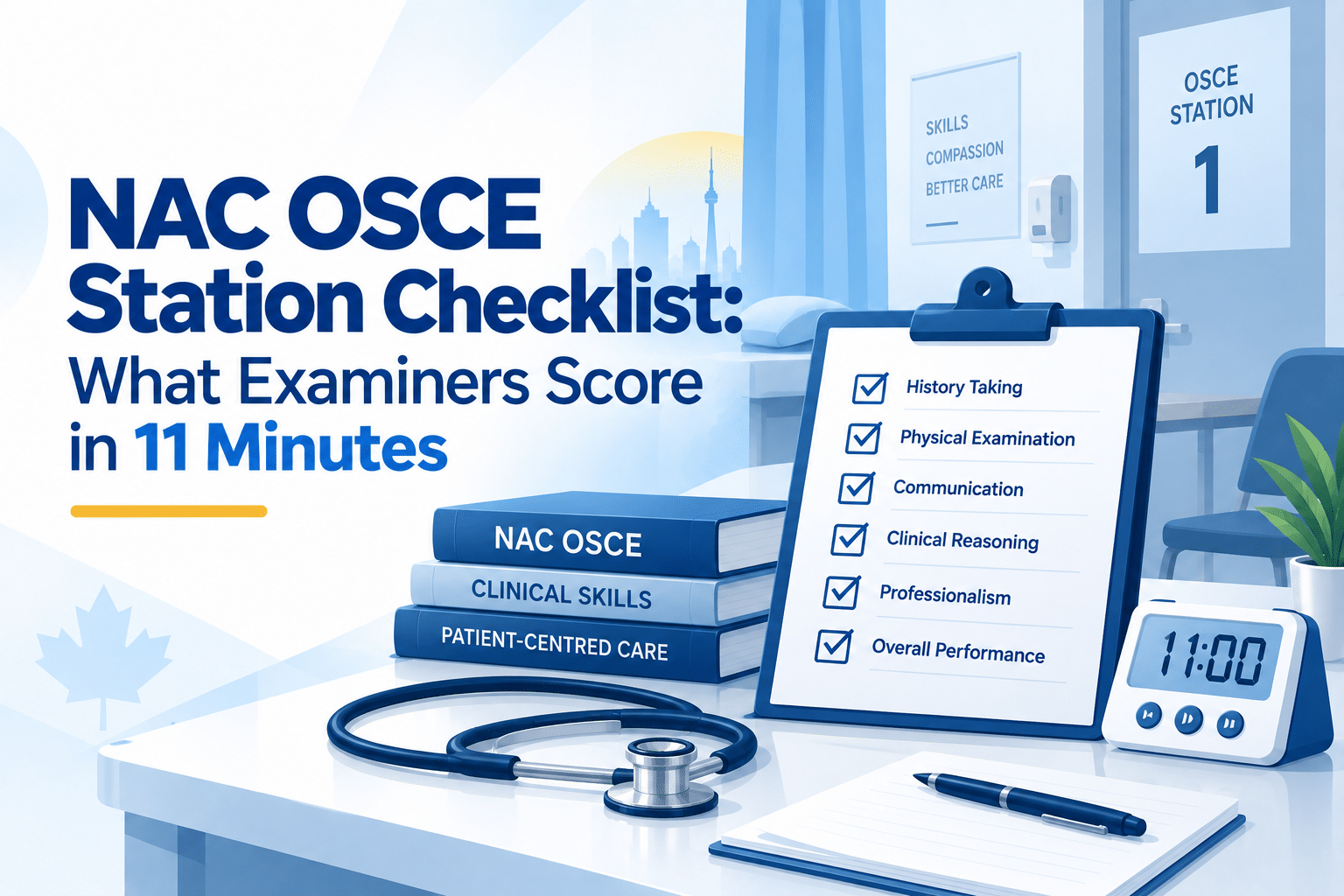
Ten days before the NAC Examination is not the time to learn new medicine. It is the time to make the eleven-minute station automatic, so that on the day your attention goes to the patient and not to the clock. This is the one-page checklist I give candidates in the final week: what examiners actually score, in the order it happens in the room. Print it, keep it beside you while you practise, and run every station against it — with a partner holding a stopwatch if you can, alone with a timer if you cannot.
Want this on one page? The free NAC OSCE station schematic puts the 11-minute clock, the mnemonics and the opening and closing scripts on a single printable sheet. The countdown, the pass rate and physician feedback options are on the NAC OSCE Help page.
Before the door – two minutes
- Read the instructions twice. Underline the task: history only, focused physical, counselling, management, or a combination. Candidates lose whole stations by doing the wrong task well.
- Note age, sex, setting and any vitals. Decide your three most likely diagnoses and the one you cannot afford to miss.
- Plan the first line you will say and the first three questions you will ask. Enter the room with a structure, not a blank.
The opening – first 45 seconds
- Introduce yourself by name and role. Confirm the patient’s name and how they would like to be addressed.
- State why you are there (“I understand you’ve come in with chest pain today”) and ask an open question.
- Ask what worries them most. Examiners score it, and the answer often points to the diagnosis and the counselling they need.
- Ask permission before you begin, and again before any examination.
History stations – focused, not complete
- Characterise the presenting complaint fully before anything else: onset, duration, character, site, radiation, severity, timing, what makes it better or worse, associated symptoms.
- Ask the red-flag questions for your three differentials out loud, even when the answer is obviously no — an unasked question is unscored.
- Past history, medications and allergies, family history, and the social history that matters for this presentation (smoking, alcohol, substances, occupation, home situation, sexual history where relevant).
- Ideas, concerns and expectations: what the patient thinks is going on, what they fear, and what they hoped would happen today. One question each is enough.
- Screen the psychosocial context when the station invites it — mood, safety at home, supports. These are marked items in many NAC stations.
Physical examination – verbalised
- Wash or sanitise your hands, explain what you will do and why, and drape appropriately. Each is a scored behaviour.
- Say what you are doing as you do it: “I’m inspecting the chest for scars and deformity… now palpating for the apex beat.” In a NAC station an unspoken examination is an unscored examination.
- Follow the sequence the examiner expects — inspect, palpate, percuss, auscultate — and state your findings, positive and negative, as you go.
- Examine the relevant system properly rather than three systems superficially. If the instruction says “focused”, it means it.
- Ask about pain before you touch, watch the patient’s face, and thank them when you finish.
Counselling and management stations
- Find out what the patient already knows and how much they want to know before you explain anything.
- Explain in plain language, in small pieces, and check understanding after each piece — “Does that make sense so far?” is worth marks.
- Give a clear plan: investigations, treatment, what to do if things get worse, and when you will see them again. Offer the options and let the patient choose where there is a real choice.
- Address the concern they named at the start. If they were worried about cancer, say the word.
- Safety-net explicitly: the symptoms that mean “come back or go to emergency”.
The close – before the bell
- Two-sentence summary of what you found and what you think is happening.
- One next step, stated clearly.
- Ask whether they have any questions, and check they understood the plan.
- Thank the patient. Finish with time in hand rather than mid-sentence.
The eleven-minute clock
A pattern that works for most combined stations: opening done by 0:45; history to about 6:00; examination or counselling to about 9:30; close by 10:30 with thirty seconds spare. For a history-only station, spend the extra time on red flags and ideas-concerns-expectations, not on more of the same questions. If you hear the one-minute warning and have not started closing, stop what you are doing and close – a completed station with a thin middle scores better than a thorough history with no ending.
Where marks go missing
Running out of time, so the close never happens. Doing a full history in a focused-exam station, or examining silently. Forgetting to ask what the patient is worried about, or asking and never returning to it. Using jargon without checking understanding. Skipping consent and hand hygiene because you were nervous. Missing the psychosocial cue the standardised patient was trained to give. None of these are knowledge problems; all of them disappear with timed practice.
The last ten days
Run two or three timed stations a day, rotating systems so that paediatrics, obstetrics, psychiatry and the surgical presentations get the same attention as internal medicine. After each one, score yourself against this checklist and note the single item you missed most often; that item is the next day’s focus. Stop learning new content four days out. The day before, run three stations in the morning, then rest.
If you’re preparing further ahead, follow our 12-week NAC OSCE study plan to organise your station practice, self-scoring and mock circuits before the final ten days.
Not booked yet? The 2027 sessions and booking windows are in NAC OSCE dates 2027. Before your examination, review what to bring and how NAC exam day runs
OSCE-R has 122 timed stations across 16 systems, each with a history-taking version and a combined history-and-physical version, in English and French, built to be run solo or with any partner. It is CAD $119 for 90 days. See how it works, or sign up free and start with the sample stations.
Dr. Bilal Akil, Emergency Medicine, Schulich School of Medicine & Dentistry, Western University · founder of mccQbank. Based on the NAC Examination’s published station format (ten scored and two pilot stations of eleven minutes) and MCC‘s stated competencies — examiners score up to seven per station: history taking, physical examination, investigations, data interpretation, diagnosis, management and communication skills. Scores are reported on a 500–700 scale with a pass score of 577 (MCC: NAC results).
Sources: MCC — NAC Examination overview (station format and assessment domains); MCC — NAC Examination scheduling; MCC — NAC Examination results; MCC examination objectives. Checked September 2026.