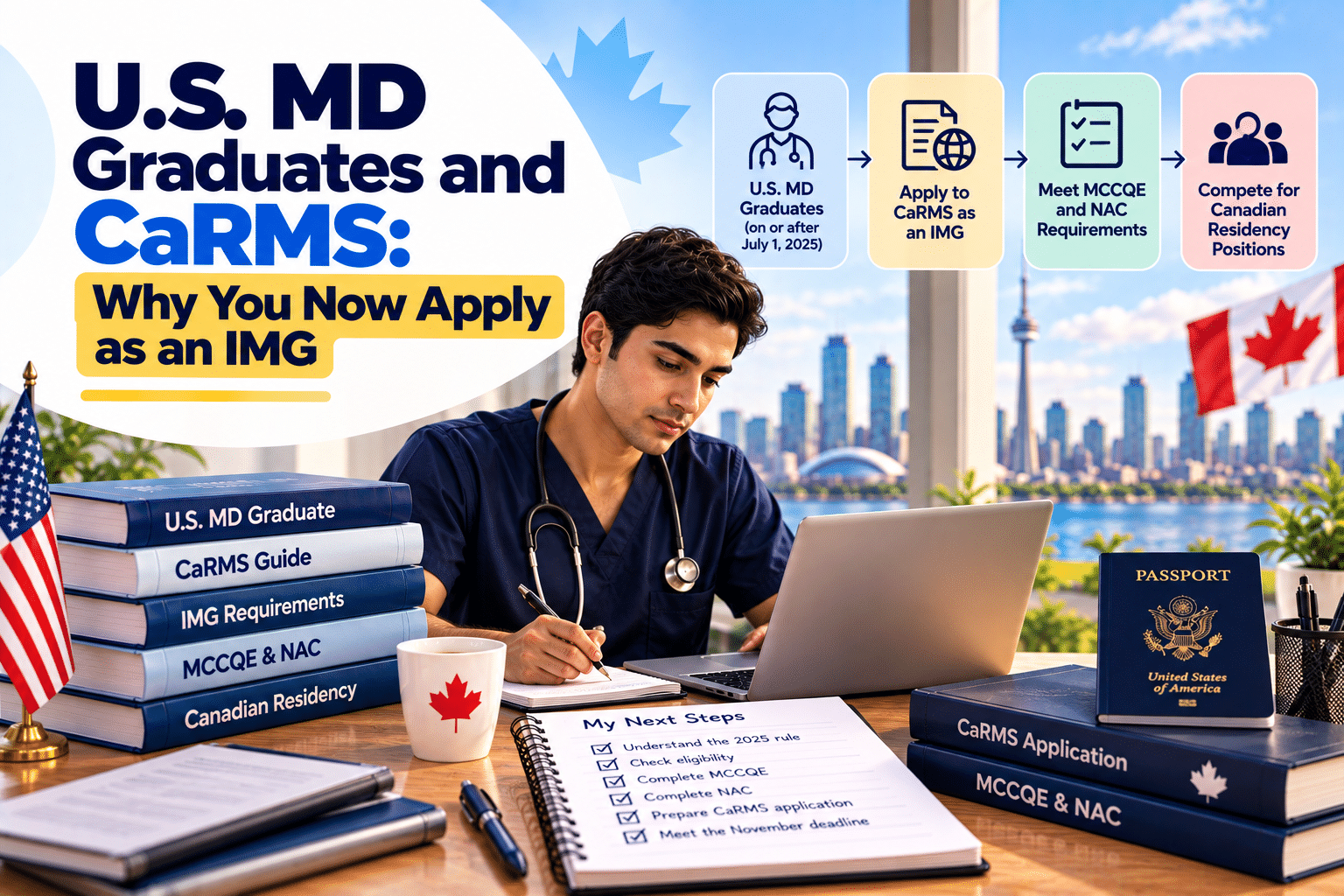
Short answer: Under the US MD graduates CaRMS eligibility rules, if you graduate from a U.S. allopathic (MD) school on or after 1 July 2025, CaRMS treats you as an international medical graduate (IMG), not a Canadian medical graduate (CMG). In practice that means the IMG rules: you generally need passes on the MCCQE and the NAC Examination (some provinces accept other exams or make exceptions), you apply to positions set aside for IMGs, and some provinces add steps of their own. As before, you must be a Canadian citizen or permanent resident; CaRMS notes some exceptions may apply. U.S. MD graduates from before that date are still CMGs, and some MD-PhD students keep CMG status under a transition exception. For the 2027 match, applications and all required documents must be submitted and assigned to programs by 26 November 2026 at 12:00 noon ET.
By Dr. Bilal Akil, MD — Emergency Medicine, Schulich School of Medicine & Dentistry, Western University · founder of mccQbank
Why the rule changed
U.S. and Canadian medical schools used to share a joint accreditation process, and CaRMS treated U.S. allopathic graduates as Canadian medical graduates under the LCME-CACMS agreement. The Association of Faculties of Medicine of Canada (AFMC) explains what ended it: “As of March 2021, the Liaison Committee on Medical Education (LCME) in the United States is no longer accrediting Canadian medical schools.” Canadian schools continue to be accredited by the Committee on Accreditation of Canadian Medical Schools (CACMS) (AFMC: Changes to LCME accreditation).
The change affecting US MD graduates CaRMS eligibility runs both ways from 1 July 2025. The AFMC says graduates of Canadian schools from that date are considered IMGs by the United States and need ECFMG certification for U.S. residency, and Canadians graduating from a school that is not CACMS-accredited on or after that date are IMGs in the Canadian residency application process. CaRMS applies the same date in its eligibility criteria.
US MD Graduates CaRMS: Which Applicant Type Are You?
| Your situation | How CaRMS treats you |
|---|---|
| MD from a U.S. allopathic (LCME-accredited) school, graduated before 1 July 2025 | Canadian medical graduate (CMG) |
| MD from a U.S. allopathic school, graduated on or after 1 July 2025 | International medical graduate (IMG) |
| Combined degree such as an MD-PhD at an LCME school, MD component started on or before 31 December 2020, program completed before 30 June 2028 | CMG under the earlier LCME-CACMS agreement; an official transcript showing the MD start date and expected completion date is required |
| U.S. osteopathic (DO) school | IMG: CaRMS lists U.S. osteopathic schools under IMG eligibility |
CaRMS says the combined-degree exception is there to accommodate learners who started their combined program before the LCME-CACMS split was announced and had already planned to return to Canada. The exception is written for combined degrees only.
US MD Graduates CaRMS: What Changes When You Apply as an IMG?
1. The MCCQE and the NAC become entry requirements
For US MD graduates CaRMS applications, basic IMG eligibility includes having “written and passed” the National Assessment Collaboration (NAC) Examination and the MCCQE, although some provinces allow exceptions. Its summary of MCC examination requirements, which like the other provincial summaries still shows 2026-match criteria, lists them. The ones most relevant to U.S. graduates:
- Nova Scotia, New Brunswick and PEI accept USMLE Steps 1 and 2 in place of the MCCQE.
- Saskatchewan accepts USMLE Steps 1, 2 and 3 in place of the MCCQE.
- Newfoundland and Labrador also accepts the LMCC in place of the NAC.
- Quebec: the Collège des médecins du Québec no longer requires the NAC for MD equivalency, but Quebec’s medical schools continue to require it for admission to residency. Quebec also has a particular stream with no MCC examination requirements for IMGs already training in Canada or the United States.
MCC results reach CaRMS only as transfers from physiciansapply.ca. On the MCC side, U.S. allopathic graduates from 1 July 2025 are eligible for the NAC, and so are U.S. MD students expected to complete all degree requirements within 15 months of the exam date. The MCC asks both students and graduates to contact it through their physiciansapply.ca account for instructions. U.S. MD graduates from before 1 July 2025 are not eligible (MCC: NAC eligibility). The NAC runs twice a year, in the spring and fall (MCC: NAC Examination). The MCCQE runs in four sessions a year, its application steps cover U.S. medical students and graduates, and you can take it up to four times (MCC: MCCQE; MCCQE eligibility). Our guides to NAC eligibility and how to apply and writing the MCCQE before you graduate cover the application steps.
2. Positions are set aside by applicant type
CaRMS explains that applicants apply through application streams: groups of positions set aside for specific applicant types, decided by provincial ministries of health. As an IMG you compete for positions open to IMGs. You also need a Medical Identification Number for Canada (MINC) in your application.
3. Some provinces add their own steps
- British Columbia, Alberta and Quebec: CaRMS says IMGs must complete an assessment before they can apply through CaRMS: the UBC Clinical Assessment Program, the Alberta International Medical Graduate Program, and recognition of the equivalence of an MD degree in Quebec.
- Ontario: the Ontario criteria for IMGs include a return-of-service commitment in Ontario starting immediately after training, a pre-residency program before residency starts, and an assessment verification period of 12 weeks or more that the College of Physicians and Surgeons of Ontario requires. The page is not fully consistent: its 2026-match section also says graduates of U.S. medical schools are eligible for IMG positions only. If Ontario matters to you, confirm your status with CaRMS (help@carms.ca) before you apply.
- Language: the United States is on CaRMS’s language exemption list for Alberta, British Columbia, Newfoundland and Labrador, Nova Scotia, New Brunswick and PEI, Manitoba and Saskatchewan, if your basic medical education and patient care experience were completed there. Ontario is not in that exemption sentence; it accepts several proofs, including a dean’s letter confirming instruction solely in English. Quebec programs set their own rules.
CaRMS notes that the provincial criteria currently shown are from the 2026 match, with 2027 criteria to be posted once each province has reviewed them. Re-check your provinces before you apply.
4. A U.S. preliminary year can cost you the first iteration
The first iteration is open to applicants with no previous RCPSC, CFPC or ACGME-accredited postgraduate training (CaRMS notes some exceptions may apply), and CaRMS states: “Preliminary training in the United States is considered accredited postgraduate training” for first-iteration eligibility. If a U.S. preliminary year is in your plans, check what it does to your CaRMS options first. For running both matches in one year, see CaRMS and the NRMP in the same year.
US MD Graduates CaRMS Application Checklist at U.S. MD schools
| Step | What to do | Why |
|---|---|---|
| 1 | Confirm your graduation date and applicant type, and your Canadian citizenship or permanent residence. MD-PhD students: request the transcript the exception requires. | Everything else depends on CMG vs IMG. |
| 2 | Open a physiciansapply.ca account. Graduates: start source verification of your medical degree. | MCC results and documents reach CaRMS through physiciansapply.ca. |
| 3 | Plan the MCCQE unless every province on your list accepts USMLE instead (NS, NB or PEI with Steps 1 and 2; Saskatchewan also needs Step 3). | Four sessions a year; up to four attempts. |
| 4 | Plan the NAC. Contact the MCC through physiciansapply.ca first, as it asks U.S. allopathic students and graduates to do. | It runs only in spring and fall. |
| 5 | If British Columbia, Alberta or Quebec is on your list, start that province’s assessment early. | It must be complete before you can apply. |
| 6 | Check language proof if Ontario is on your list (Quebec: see each program description), and get your MINC. | Both are application requirements. |
| 7 | Submit and assign everything by 26 November 2026, 12:00 noon ET, for the 2027 match. | CaRMS first-iteration deadline. |
For US MD graduates CaRMS planning, the full set of 2027 dates is in our CaRMS 2027 timeline for IMGs.
If the MCCQE is new to you after USMLE preparation, practise in its format early. mccQbank has 2,400+ bilingual, case-based MCCQE questions with explanations. Try 30 free questions.
Frequently asked questions
I graduated from a U.S. MD school in May 2025. Am I a CMG?
Yes. CaRMS treats U.S. allopathic graduates from before 1 July 2025 as CMGs.
Can a U.S. MD graduate take the NAC Examination?
Under the US MD graduates CaRMS eligibility rules, U.S. MD graduates from 1 July 2025 are eligible for the NAC Examination, as are U.S. MD students who will complete their degree requirements within 15 months of the exam. The MCC asks both to contact it through physiciansapply.ca for instructions. Graduates from before 1 July 2025 are not eligible, and as CMGs they do not need the NAC for CaRMS.
I passed USMLE Steps 1 and 2. Do I still need the MCCQE?
For most provinces, yes. Nova Scotia, New Brunswick and PEI accept USMLE Steps 1 and 2 in place of the MCCQE, and Saskatchewan accepts Steps 1, 2 and 3. The NAC is still required in most provinces, with the exceptions listed above.
Does the change affect Canadians who want to train in the U.S.?
Yes. The AFMC says graduates of Canadian schools from 1 July 2025 are considered IMGs by the United States and need ECFMG certification for U.S. residency.