By Dr. Bilal Akil, MD — Emergency Medicine, Schulich School of Medicine & Dentistry, Western University · founder of mccQbank
The National Assessment Collaboration (NAC) Examination is a half-day OSCE, but you will spend about five hours at the centre, and much of what goes wrong has nothing to do with medicine: a watch on your wrist, an unsigned confidentiality page, or a rushed decision to sit while unwell.
This NAC exam day guide covers what to bring, what stays at registration, how the station clock works and what to do if something goes wrong. Every rule comes from the Medical Council of Canada’s (MCC) own pages, linked throughout and read on 11 October 2026. If you have not applied yet, start with our NAC eligibility and application guide.
The short answer
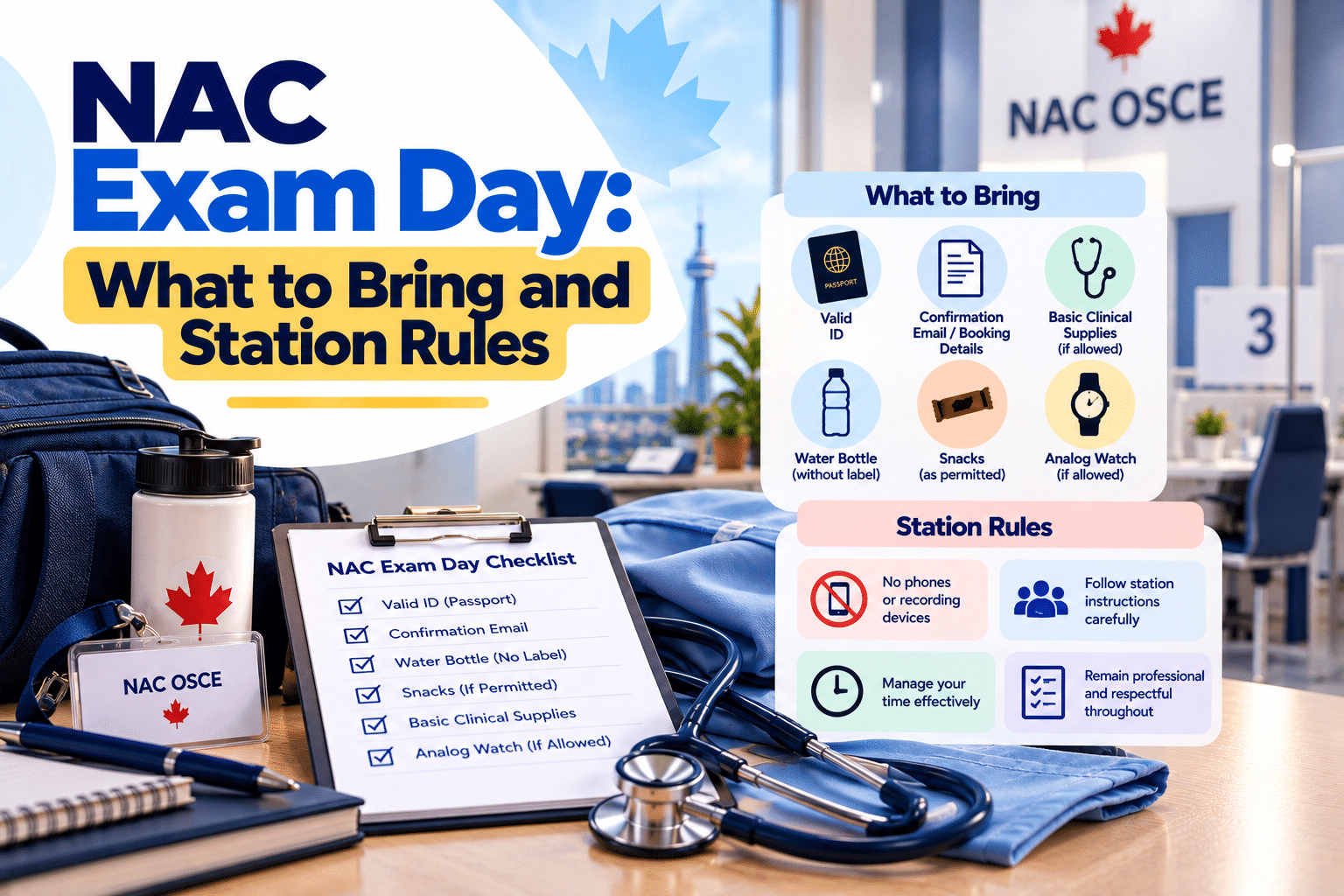
- Bring a plain white lab coat (no crest, or tape over it), a stethoscope, your printed Entrance Card and the signed Candidate Confidentiality Agreement page.
- Watches, phones, wearables, pens, paper, large bags and your reflex hammer do not go into the exam area.
- Plan on about five hours at the centre. The exam itself takes about 3.5 hours.
- Each station runs 11 minutes from the signal, with 2 minutes to move and read the next door.
- Once you start the exam, it counts as an attempt. Report any problem to site staff on the day and to the MCC within 7 days.
Your NAC exam-day timeline
The MCC sends everything through physiciansapply.ca. To help you prepare for NAC exam day, here is the sequence from centre assignment to results, drawn from the MCC’s NAC scheduling page, exam day page and candidate guide.
| When | What happens | What you do |
|---|---|---|
| About 6 weeks before | A message with your exam date and assigned centre | Check it. Centre changes are not possible. |
| About 4 weeks before | Your Entrance Card package: arrival time, centre location and instructions | Print both pages and sign page 2, the Candidate Confidentiality Agreement. |
| Before exam day | The mandatory candidate orientation module and the test security video | Complete both. The orientation is not reviewed on exam day. |
| Exam morning | Registration, with a visual inspection of everything you take into the exam | Arrive on time but no more than 15 minutes early. More than 15 minutes late, and you may be denied entry. |
| At the centre | About 5 hours: registration, orientation, the exam (about 3.5 hours) and deregistration | During the exam, speak only to exam staff. |
| Within 7 days | Deadline to report an exam-day incident through physiciansapply.ca | Report it even if you told staff on the day. |
| Within 15 days | Deadline for a partial-refund request if extenuating circumstances kept you away | Email documentation to service@mcc.ca. |
| About 8 weeks after | Results in physiciansapply.ca | For the September 2026 sitting, the MCC lists late November 2026. |
What to bring on NAC exam day, what is allowed and what stays at registration
On NAC exam day, you must disclose everything you are taking into the exam and present it for a visual inspection at registration, either at the desk or somewhere more private. The MCC sorts items into four groups (MCC: NAC exam day):
| Group | Items |
|---|---|
| You must bring | A plain white lab coat with no university or hospital crest (you may cover a crest with tape); a stethoscope; a printed copy of your Entrance Card (colour not needed); the printed and signed Candidate Confidentiality Agreement page |
| Allowed without advance notice | A small nut-free, low-to-no-smell, noise-free snack in a zip-lock bag and a clear plastic water bottle, carried in your lab coat pocket (eat before or after the exam or at a wait station); medication and items such as an EpiPen, inhaler, glucometer, unwrapped lozenges, menstrual products, lip balm, eyeglasses or a face mask (full list on the MCC page) |
| Needs a test accommodation | Any medical device that needs continuous access to a smartphone (for example, a glucose monitor or hearing aids); a breast pump; mobility aids (scooter, wheelchair, chair); syringes or needles |
| Not permitted in the exam area | Masks with exhalation valves or vents; mouth shields; coats; keys; wallets and purses; documentation of any kind; phones, tablets, smart glasses, fitness trackers and other devices; watches of any kind; pens, pencils and paper; tissues (provided on site); large bags; reflex hammer |
Three details from the MCC’s candidate guide catch people out: dress is business casual (no jeans, shorts, sweatpants, sweatshirts, hoodies, T-shirts or hats), scented products are not allowed, and no food is provided, so your pocket snack is all you get. The guide also says COVID-19 measures are still in place at NAC centres: you wear a mask for the whole exam, and one is supplied if needed.
You get one small notebook, with your barcode labels attached. Your notes are not scored, there is no second notebook, and it must go back intact at sign-out. If you need anything from the accommodation group, ask through the MCC’s test accommodations process before the session’s documentation deadline, not on the day.
How the 11-Minute Stations Work on NAC Exam Day
The exam has 12 stations, 2 of which are pilot stations that do not count toward your score. Each station is 11 minutes long, with 2 minutes between stations, plus wait stations with no task: the MCC’s NAC overview says two to three, its exam day page two to four. Each station has at least one standardized participant and an examiner, usually a physician, who scores you with standardized tools on up to 7 competencies.
Door instructions give the patient’s name and age, the setting (family practice clinic or emergency department) and the station type, and may add the presenting problem, vital signs, test results or family history. You can take notes while you wait.
| Time | Station with oral questions | Station without oral questions |
|---|---|---|
| 2 minutes before the signal | Move, read the door, make notes | Same |
| 0:00 (signal) | Your 11 minutes start, whether or not you have entered | Same |
| 0:00 to 8:00 | Patient encounter; you may go back to the patient until the 8-minute warning | Patient encounter |
| 8:00 | The examiner starts the oral questions; you cannot return to the patient | You may still go back to the patient |
| 11:00 (final signal) | Leave and move to the next station | Leave and move to the next station |
Extra time spent reading outside the door comes out of your 11 minutes. And finishing early does not end the station: you wait quietly and may not leave early. Each station has a clock for pacing.
In physical examination stations, say what manoeuvre you are doing and what finding you are looking for, and describe what you find. The participant simulates findings, and the examiner gives an oral prompt when a finding cannot be simulated. Do not perform genital, rectal, vaginal, breast, reflex or other sensitive examinations; if one is needed, tell the examiner. Station-by-station technique is in our NAC OSCE station checklist.
If something goes wrong on the NAC exam day
The MCC’s rules turn three bad-morning scenarios into clear choices:
| Situation | What the rules mean | Deadline |
|---|---|---|
| You are too unwell to sit | Starting counts as an attempt “even if you cannot finish it”. If you stay away, you forfeit the $3,320 application fee, unless the MCC accepts extenuating circumstances; then it refunds the fee minus a $1,660 administration fee. | Documentation to service@mcc.ca no later than 15 days after the exam |
| Something goes wrong during the exam (illness, a procedural problem) | Tell site staff at once, then report it through physiciansapply.ca. | 7 days. After that the MCC will not investigate, and you cannot request a reconsideration of your result. |
| You know the examiner or the participant | A family member, a significant business or social relationship, or a professional colleague is a conflict of interest; simply knowing someone generally is not. Leave the station and tell staff. | Message the MCC within 7 days |
Why this matters: you can take the NAC at most three times, pass or fail, and never in consecutive sessions (MCC: NAC eligibility and application). A wasted attempt can cost a year as well as one of three tries. If you know in advance that you cannot sit, withdraw in physiciansapply.ca before the partial-refund deadline: you get the application fee back minus a $538 withdrawal fee. There is no deferral; you withdraw and reapply. Session timing is in our NAC OSCE dates 2027 guide.
Confidentiality: the rule that follows you home
You may not discuss or share exam content at any time, before, during or after the exam, including patient portrayals, findings, oral questions and cases. Comparing patient responses with colleagues and posting online are both breaches. The MCC’s exam day page says it monitors breaches; consequences can include being denied a final result, being reported to regulatory authorities and being barred from future MCC exams. Debrief on your performance, not the cases.
Rehearse the day, not just the content
The MCC publishes free NAC resources: two videos (navigating an OSCE, and communicating with standardized participants) and sample cases for role-play with peers. Practise them in your lab coat, without a watch, at 2 plus 11 minutes per station, so the format feels familiar on NAC exam day. Results arrive about 8 weeks later; our guide to reading your NAC score report explains them.
If the MCCQE is also on your list, build the same timed habit for its multiple-choice format: try 30 free questions in mccQbank.